Oakley Kitchen Sink Backpack Review 2026: Worth Buying?
The Oakley Kitchen Sink backpack carries a bold name and a bolder promise. Oakley says you can throw almost everything you own inside it. A 34L main body, a shoe garage at the bottom, a side loading laptop sleeve, and metal hardware that looks like it came off a parachute rig.
It costs real money, and it weighs more than most rivals. So the honest question in 2026 is simple. Does this pack still earn a spot on your shoulders, or has the rest of the market caught up and passed it?
I used this pack for daily commutes, gym runs, two short flights, and one messy rainy week. This review covers what it does brilliantly, what it does badly, and who should walk away. No fluff, no marketing copy, just the parts that matter before you spend.
In A Nutshell:
- Capacity is the headline feature. The Kitchen Sink holds 34 liters across a top loading main compartment, a front organizer panel, a padded top lid pocket, a side access laptop sleeve, and a sealed bottom shoe compartment. You can pack a work day and a gym session at the same time without stuffing anything.
- Build quality feels premium in the hand. The 100% nylon shell, metal lid hardware, and abrasion resistant liners feel far tougher than typical school packs. The water repellent coating and the lined interior saved my laptop from a leaking bottle.
- Weight is the biggest flaw. The pack sits near 2 to 3 pounds before you add anything. Lighter rivals of similar size weigh a full pound less. You feel that difference by the end of a long walking day.
- Strap hardware is the weak point. Long term users and field reviewers report chest strap retainers popping loose and stitching fraying under load. Oakley built a tank and then bolted on average straps.
- Main compartment access annoys some people. The top loading rucksack style opening means digging when the bag is full. Panel loading packs beat it here.
- Best fit: commuters, students with a 17 inch laptop, gym goers, and short trip travelers who value organization over ounces.
Oakley Kitchen Sink Backpack Overview


Last update on 2026-11-14 / Affiliate links / Images from Amazon Product Advertising API
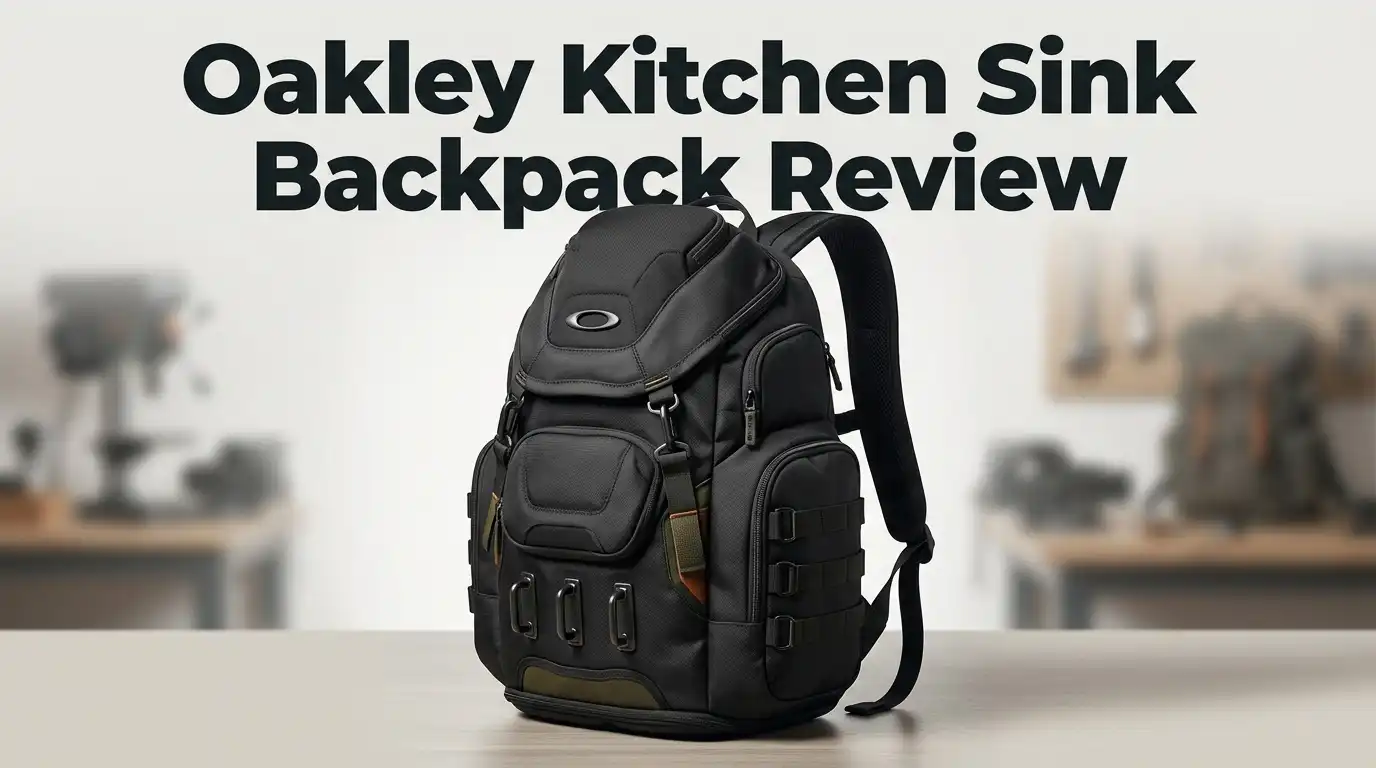
The Kitchen Sink sits at the top of Oakley’s bag lineup, above the smaller Bathroom Sink and beside the larger Big Kitchen. Oakley lists the volume at 34 liters. Dimensions run roughly 20 inches tall, 14 inches wide, and 8 inches deep. The shell uses 100% nylon with a water repellent coating, and the inner compartments use abrasion resistant fabric.
The layout is where this pack separates itself. You get a top loading main compartment with a lid that clips shut using metal parachute style hardware. A compression molded pocket on the lid protects sunglasses, earbuds, or a small camera. A side zip sleeve swallows a 17 inch laptop. A front organizer panel holds pens, cables, and a mesh optics pocket. Metal attachment rings on the exterior let you clip a helmet, a carabiner, or a second pouch.
Then comes the party trick. The bottom panel opens into a separate lined compartment sized for shoes or wet gear. Nothing damp touches your clean clothes or your laptop. Oakley retails the pack near $225, though street pricing has hovered closer to $140 for the Stealth Black version.
The short version: this is a maximalist pack for people who hate leaving things behind.
Unboxing Experience And First Impressions
The Kitchen Sink arrives compressed and flat, wrapped in a plastic sleeve with paper stuffing in the lid pocket. There is no fancy box, no branded dust bag, no printed manual. You pull it out, shake it, and the pack springs into shape. That plainness feels right for a bag built to get scuffed.
The first thing you notice is weight. You lift an empty backpack and your brain expects nothing. This one pushes back. The metal lid clips, the molded back panel, and the thick nylon all add mass you feel instantly.
The second thing you notice is the hardware. The lid clips snap with a satisfying metallic click, not a plastic tick. The zipper pulls use coated wire loops with a rubber grip. The Oakley ellipse badge sits on the lid, low key rather than loud.
Then the discovery phase starts, and it takes a while. I found the bottom shoe compartment, the side laptop zip, the hidden slot behind the shoulder straps, and two small mesh pouches I still have no real use for. Opening this bag for the first time feels like exploring a house with too many closets.
First impression verdict: expensive feeling, genuinely tough, and heavier than expected. That last point never fully goes away.
Design And Build Quality In Daily Use
The design language reads tactical without shouting. In Stealth Black the pack looks clean when fully zipped, so it passes at an office as easily as at a trailhead. Camo and graphite versions lean louder, and they draw more comments.
Build quality on the body is excellent. The nylon shrugs off scrapes against concrete and car door frames. The base fabric resists scuffing even after being dragged across airport floors. The molded back panel keeps the pack standing upright on its own, which sounds minor until you compare it to slouchy rivals that flop over and spill.
The hardware split is the real story. Metal lid clips and aluminium accents feel bombproof. The strap hardware does not match that standard. Field reviewers with heavy use report chest strap retainers popping off internal wires and stitching unraveling at stress points. I did not break mine, but the chest strap webbing feels thin compared to the rest of the pack.
Stitching elsewhere is tidy, with bar tacks at the haul handle and shoulder joins. The interior liners are the quiet hero. A water bottle leaked in my main compartment and the lined divider stopped it reaching the laptop sleeve entirely.
So the body deserves an A grade. The straps deserve a B minus. That gap defines the pack.
Storage Layout And Real World Capacity
Thirty four liters sounds moderate on paper. In practice this pack carries more than the number suggests because the compartments stay separate and usable.
Here is what fit in a single work and gym day. A 17 inch laptop in the side sleeve. A charger, a mouse, and two cables in the front organizer. Sunglasses and earbuds in the molded lid pocket. A change of clothes, a towel, and lunch in the main compartment. Running shoes in the bottom garage. Nothing was crushed and nothing had to be left on the desk.
The front organizer panel handles small items well. Pen slots, a zip mesh pocket, and card slots keep pens from migrating into the abyss. The mesh optics pocket holds a glasses case without pressure.
The weakness is main compartment access. The lid unclips and the top opens like a rucksack, so items at the bottom require digging. A clamshell pack lets you see everything at once. This one does not.
Two small exterior mesh pouches feel like leftovers from a design meeting. They are too loose for a phone and too shallow for a bottle. I ignored them completely after week one. Not every pocket on this pack earns its stitching.
Top 3 Alternative for Oakley Kitchen Sink Backpack

Last update on 2026-11-14 / Affiliate links / Images from Amazon Product Advertising API
Oakley Big Kitchen Backpack

Last update on 2026-11-14 / Affiliate links / Images from Amazon Product Advertising API
Oakley Enduro 3.0 Big Backpack

Last update on 2026-11-14 / Affiliate links / Images from Amazon Product Advertising API
5.11 Tactical Rush 72 2.0 Backpack
Laptop Protection And Tech Storage
The side loading laptop sleeve is one of the smartest features on this pack. You unzip the panel on the side and slide the machine in without opening the main lid. At airport security this saves real time. No unclipping, no emptying, no repacking while people sigh behind you.
The sleeve fits a 17 inch laptop with room to spare. A 16 inch MacBook Pro slides in loosely, which means the machine shifts a little during walking. A thin sleeve or folio solves that and I recommend one. Padding on the panel is decent but not the thickest I have used, so the pack protects against bumps rather than hard drops.
The molded lid pocket is the best tech nook here. It was designed years ago for media players, and now it perfectly holds earbuds, a power bank, a small camera, or sunglasses. The hard shell resists crushing when the bag gets tossed into an overhead bin.
Cable management lives in the front organizer. Two zip areas keep chargers, dongles, and pens separated. I never had a charger tangle around a mouse cord.
One gap stands out. There is no dedicated tablet slot. A tablet has to share the laptop sleeve or ride in the main compartment. For a pack with this many pockets, that omission surprises me.
The Bottom Shoe And Wet Gear Compartment
This is the feature people fall in love with. Unzip the base panel and you get a fully lined compartment separated from everything above it. It looks shallow at first glance. It is not. A pair of size 11 running shoes fits with a little pushing.
I used it three ways. Gym shoes after a workout. A damp swim towel and trunks after the pool. A wet rain shell after a downpour. In every case the smell and moisture stayed down there. Nothing wet touched my clothes, laptop, or lunch.
The liner wipes clean with a damp cloth, which matters more than you expect after muddy trail shoes. The zipper runs along the base edge and has held up without snagging.
There are two catches worth knowing. First, the shoe compartment eats into the main compartment volume when it is full, because the space is shared through a flexible divider. Load shoes and you lose some depth above. Second, the base zipper sits close to the ground when you set the bag down, so it collects grit on wet pavement.
Still, this compartment alone justifies the pack for gym goers and swimmers. No competing feature has made me change my routine this much.
Comfort When The Pack Is Full
Comfort depends entirely on load. Under about 15 pounds the pack rides beautifully. The molded back panel creates airflow channels, so sweat build up stays lower than with flat panel packs. The mesh lined shoulder straps spread pressure well across the collarbone.
Add the waist belt and the pack sits closer to your spine, which helps on a long walk or a bike ride. The padded back also stops sharp items from poking you, a real benefit when the main compartment is packed tight.
Above roughly 20 pounds the story changes. The straps are not wide enough for that kind of load, and the frameless body lets weight sag low. Hot spots form on the shoulders after an hour. A proper hiking pack with a load bearing frame handles the same weight far more comfortably.
The chest strap is the part I trust least. Reviewers with serious mileage report it detaching from its retainer wire mid hike, and once it pops free the whole load distribution system collapses. Mine held, but I stopped relying on it for anything heavy.
My honest advice: treat this as an urban and travel pack that occasionally hikes, not a trekking pack. Keep it under 20 pounds and it stays pleasant all day.
What The Oakley Kitchen Sink Does Not Do Well
Every honest review needs this section, so here it is in plain terms.
Weight is the headline problem. The pack lands between 2.2 and 3 pounds empty depending on the version and how you weigh it. A North Face Recon at 30 liters weighs closer to 2.5 pounds, and lighter commuter packs of similar volume come in under 2 pounds. You carry that penalty every single day.
Strap hardware does not match the body. The chest strap retainer design is fragile and the stitching at stress points has failed for real users under load. For a pack that looks over engineered, this is the most frustrating flaw.
Main compartment access is slow. The top loading design forces digging. If you pull items in and out constantly during the day, a clamshell pack will annoy you far less.
Some pockets are pure decoration. Those little exterior mesh pouches serve no purpose I could find.
It is bulky on crowded transit. The pack keeps its shape even when half empty, so it takes space on a packed train and bumps people in tight aisles.
None of these break the pack. All of them are fair reasons to choose something else. Know the tradeoffs before you commit.
Water Resistance Tested In Real Rain
Oakley calls the shell water repellent, not waterproof. That distinction matters and I tested it honestly.
In light rain for 20 minutes, water beaded on the nylon and rolled off. Nothing inside got damp. In a heavier 15 minute downpour, the fabric panels still held, but moisture worked in around the zipper teeth and the lid seam. Zippers are the weak point, as they are on almost every pack without storm flaps.
The interior liners provide a second line of defense. Because the laptop sleeve, the main compartment, and the shoe garage are separately lined, a leak in one place does not travel. This design saved me when a bottle cap loosened inside the main bay.
The coating also wears down over time. After months of use and a few cleanings, water starts soaking instead of beading. A spray on durable water repellent treatment restores most of that performance for a few dollars.
My guidance is simple. Commuting in drizzle is fine. Cycling through a storm or carrying electronics in tropical rain needs a rain cover or a dry bag inside. Do not trust any water repellent pack with an unprotected laptop in serious weather.
Travel And Carry On Performance
The Kitchen Sink works well as a personal item on a flight. At roughly 20 by 14 by 8 inches it fits under most airline seats, though a fully stuffed pack becomes tight and may need to go overhead.
The side laptop zip shines at security. Pull the machine, drop it in the tray, walk on. No other feature on this pack saves more stress during travel.
Organization helps on the road too. Passport and phone live in the back pocket close to your body. Chargers stay in the front panel. The lid pocket holds sunglasses and earbuds within instant reach. The bottom compartment becomes a laundry bag by day three of any trip, which keeps dirty clothes away from clean ones.
The drawback again is weight. Airlines with strict personal item limits in Europe and Asia will notice a pack that starts at nearly 3 pounds before contents. That weight comes straight out of your allowance.
The metal hardware also draws occasional attention from security staff, though I was never asked to open the bag. For weekend trips of two or three days, this pack handles everything. For a full week, step up to the larger Big Kitchen model instead.
Pros And Cons
Pros
- Huge usable capacity across 34 liters with genuinely separated compartments, so a work day and a gym session coexist without compression.
- Side access laptop sleeve fits up to a 17 inch machine and speeds up airport security enormously.
- Bottom shoe and wet gear compartment keeps damp or dirty items fully isolated from clothes and electronics.
- Tough nylon shell with water repellent coating and abrasion resistant liners that shrug off daily scuffing.
- Metal lid hardware and attachment rings feel premium and allow external gear clipping.
- Molded back panel provides airflow and lets the pack stand upright on its own.
- Stealth Black styling looks sharp in an office and on a trail.
Cons
- Heavy when empty, near 2 to 3 pounds, which is a full pound more than several rivals of similar volume.
- Chest strap retainer and strap stitching are documented weak points under heavy or repeated load.
- Top loading main compartment forces digging compared with clamshell packs.
- No dedicated tablet pocket, which is odd on a pack with this many compartments.
- Small exterior mesh pouches serve almost no practical purpose.
- Bulky footprint on crowded buses and trains even when half empty.
- Retail pricing near $225 feels high, so waiting for a sale is smart.
Price And Value In 2026
Oakley lists the Kitchen Sink near $225 at full retail. That number is hard to justify against the competition. Street pricing is a different conversation. Stealth Black versions have regularly sold closer to $140, and Oakley sale events often cut accessory prices by 30% or more. Preowned examples show up from around $100.
At $140 or below, the value looks solid. You get 34 liters, a 17 inch laptop sleeve, a lined shoe compartment, metal hardware, and a shell that outlasts cheaper packs. Few bags at that price offer this much compartment separation.
At full retail, the comparison gets harsh. For $225 you can buy a lighter travel pack with a better harness, a lifetime warranty, and faster clamshell access. You would be paying a premium for the Oakley name and the shoe garage.
Durability helps the long term math. The body of this pack lasts years with normal use, and owners on enthusiast forums report keeping theirs for a decade. If the straps hold, the cost per year drops low.
My verdict on value: buy it on sale, skip it at full price. Set a price alert and be patient. This pack goes on discount often enough that paying sticker feels unnecessary.
Who Should Buy It And Who Should Skip
Buy it if you carry a lot and hate sorting. Students with big laptops, commuters who hit the gym, swimmers, and people who live out of one bag all week will love the compartment separation. The shoe garage alone changes routines.
Buy it if you value toughness over ounces. This pack survives being thrown in truck beds, dragged through airports, and stuffed past capacity. If your current bag keeps dying, this one will not.
Buy it if you like the look. The tactical styling with clean lines gets compliments constantly, and Stealth Black stays professional enough for an office.
Skip it if weight matters to you. Runners, cyclists, and anyone walking miles daily will resent the base weight. Lighter options do 90% of the job for a pound less.
Skip it if you need constant quick access. Top loading means digging. A clamshell commuter pack serves you better.
Skip it if you plan serious hiking. The harness and chest strap are not built for 25 pound loads over mountain terrain. Buy a framed hiking pack instead.
One last consideration. If you want everything this pack offers plus a few more liters and front loading access, look at the Big Kitchen model instead. It solves the access complaint while keeping the same DNA.
Final Verdict
The Oakley Kitchen Sink in 2026 remains a genuinely useful, genuinely flawed backpack. The storage system is excellent, the shell is tough, and the bottom wet compartment is still one of the best features in any daypack. The weight and the strap hardware hold it back from greatness.
I would recommend it to a student, a commuter, or a gym regular who buys on sale and keeps loads moderate. I would steer a light packer or a hiker somewhere else without hesitation.
If you want one bag that handles a messy, unpredictable day and looks good doing it, this pack delivers. Just carry it knowing exactly what you traded away to get all that space.
Frequently Asked Questions
How many liters is the Oakley Kitchen Sink backpack?
The Kitchen Sink holds 34 liters. That places it in the medium to large daypack category. The larger Big Kitchen model holds 35 liters with a front expandable section, and the smaller Bathroom Sink sits below both.
Is the Oakley Kitchen Sink waterproof?
No. It is water repellent, not waterproof. A coating on the nylon shell sheds light rain and spills, and the interior liners block leaks between compartments. Heavy sustained rain can work in through the zippers, so use a rain cover or a dry bag for electronics.
Does the Kitchen Sink fit a 17 inch laptop?
Yes. The side access padded sleeve fits a 17 inch laptop comfortably. A 16 inch machine sits a little loose, so adding a thin sleeve reduces movement and improves protection.
How much does the Oakley Kitchen Sink weigh?
Listings place the empty weight between roughly 2.2 and 3 pounds depending on the version and the source. Either way, it is noticeably heavier than most 30 liter commuter packs, and that weight is the most common complaint from owners.
Is the Kitchen Sink good for hiking?
It works for short day hikes with light loads. It is not a substitute for a framed hiking pack. The shoulder and chest straps are the weakest parts of the design and struggle with heavier weight over long distances.
Can the Kitchen Sink work as airline carry on?
Yes, as a personal item. It fits under most airline seats when packed moderately. A fully stuffed pack may need overhead space, and strict airlines will count its base weight against your allowance.
Does the shoe compartment really fit shoes?
It does. Running shoes up to about size 11 fit, and the lined interior isolates moisture and odor. Loading shoes reduces available depth in the main compartment above, since the two spaces share volume through a flexible divider.
Is the Oakley Kitchen Sink worth the price?
On sale near $140 or below, yes. At full retail near $225, the value weakens because lighter packs with better harnesses and stronger warranties exist at that price. Watch for Oakley sale events before buying.

Hi, I’m Luna Beck — the founder and voice behind Urban Pack Vault. I’m passionate about helping people find bags that perfectly match their lifestyle. From backpacks to travel luggage, I research, review, and recommend so you never have to second-guess your next purchase.