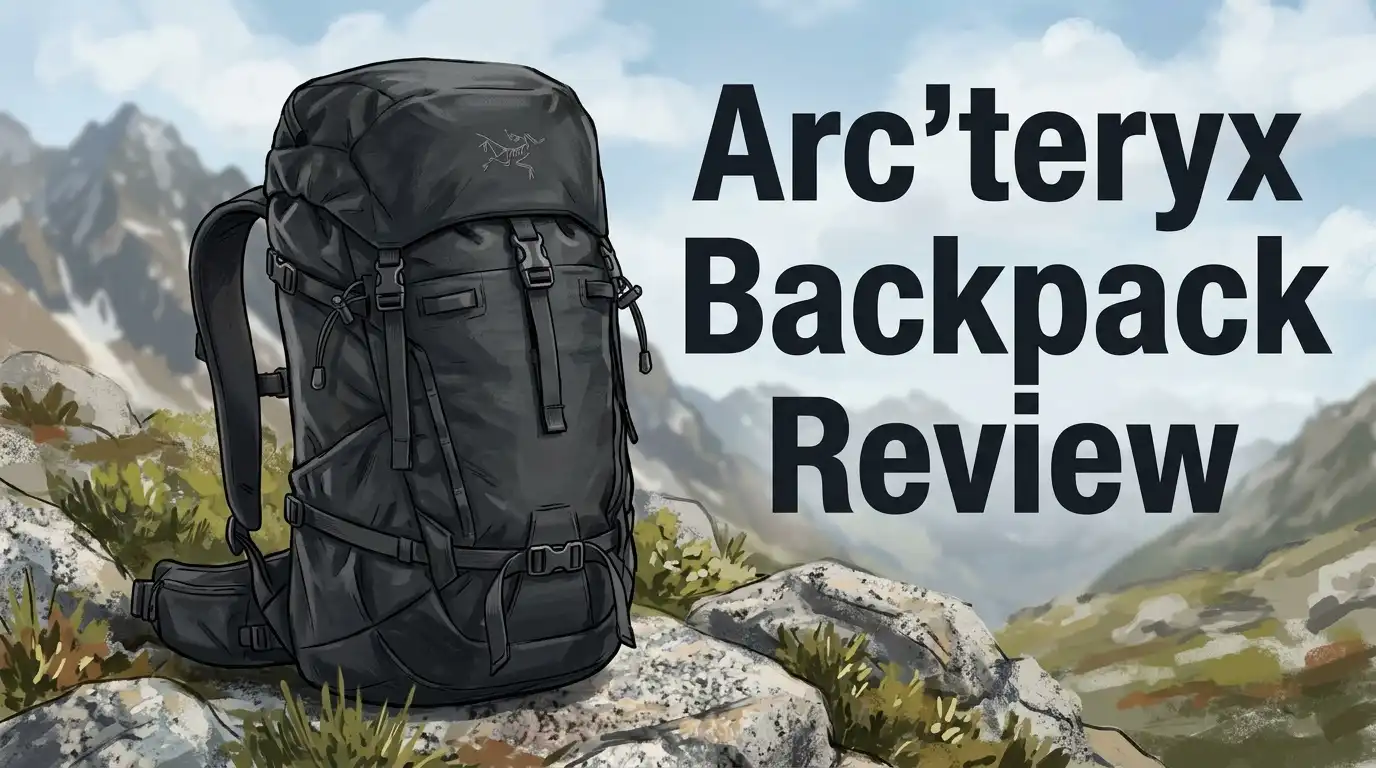
Arc’teryx Backpack Review 2026: Worth It?
Arc’teryx backpacks carry a serious price tag. You see one on a train platform, you notice the dead bird logo, and you wonder if the bag really earns that money. I asked the same question.
So I bought two of the brand’s most popular daypacks, used them through commutes, airports, rain, and weekend trails, and tracked every small annoyance along the way.
This review covers what Arc’teryx packs do brilliantly and where they fall short. I share real weights, real capacities, and honest complaints that marketing pages skip. By the end you will know which model fits your life, which one to skip, and whether a cheaper bag does the same job.
In a Nutshell:
- The Mantis 26 is the best all rounder. It holds 26 liters, weighs under 1.9 pounds, and costs $160 at Arc’teryx. It works for office days, gym runs, and short hikes. One bag, many jobs.
- Build quality is genuinely excellent. Stitching stays tight. Zippers glide after hundreds of pulls. Fabric resists abrasion better than most packs in this class. Owners on forums report ten and fifteen year lifespans.
- The price hurts. You pay roughly double what an Osprey or Patagonia daypack costs. The extra money buys durability and finish, not extra features.
- Organization is simple, almost too simple. Arc’teryx favors clean lines. You get fewer pockets than competing bags. Gear organizers love pockets. Arc’teryx gives you restraint instead.
- The Granville 25 handles rain best. Its coated fabric sheds water without a cover. The trade off is breathability. Your back will sweat in summer heat.
- Warranty support is strong. Arc’teryx repairs or replaces manufacturing defects for the practical lifetime of the product.
Arc’teryx Mantis 26 Backpack

Last update on 2026-10-28 / Affiliate links / Images from Amazon Product Advertising API
The Mantis 26 is the pack most people mean when they say Arc’teryx backpack. It holds 26 liters. It weighs about 840 grams. It measures 47.5 cm tall and 27.5 cm wide, which fits under most airline seats.
The main compartment uses a drawbridge opening. You unzip and the front panel folds down, so you see everything at once. No digging. An internal sleeve swallows a 15 inch laptop or a hydration bladder.
The carry system punches above its weight. A padded back panel, a frame sheet, and an aluminum stay spread the load across your spine. Loads near 15 pounds still feel balanced.
Two stretch side pockets hold bottles, a windshell, or a compact camera. The waist belt removes in seconds. That single detail makes the bag look office appropriate instead of trail ready.
Unboxing the Mantis 26
The box arrives plain. Arc’teryx ships in recycled cardboard with no plastic window and no foam. You lift the lid and the pack sits folded inside a thin paper sleeve. A small hangtag explains the Fair Trade certified factory. That is the whole presentation.
First impression? The fabric feels dense. Run your thumb across it and you feel a tight weave rather than a slick coating. The nylon has a quiet matte finish that photographs darker than it looks in person.
Zipper pulls are thin cord, not bulky plastic. They lie flat. The aluminum stay gives the back panel a subtle spring when you press it.
Weight surprised me most. The empty bag feels almost hollow for its size. You expect heft at this price. You get the opposite, which is exactly the point.
Arc’teryx Granville 25 Backpack

Last update on 2026-10-28 / Affiliate links / Images from Amazon Product Advertising API
The Granville 25 takes a different path. It targets commuters who ride through rain. The shell uses a coated weather resistant fabric with sealed construction, so water beads and rolls off instead of soaking in.
Capacity sits at 25 liters. Dimensions run 49 cm long, 33 cm wide, and 24 cm deep. A laminated laptop sleeve sits against the back panel and keeps your machine dry during a downpour.
The roll style closure seals the top. You fold, you clip, and the opening disappears. A quick access pocket on the front holds keys, a transit card, and a phone.
Honest warning here. The Granville breathes poorly. Riders on forums report a soaked shirt after twenty minutes of summer cycling. The panel blocks water in both directions. Buy it for wet climates, not hot ones.
Top 3 Alternative for Arc’teryx Mantis 26
No products found.
Osprey Daylite Plus Commuter Backpack

Last update on 2026-10-28 / Affiliate links / Images from Amazon Product Advertising API
Patagonia Black Hole Pack 25L

Last update on 2026-10-28 / Affiliate links / Images from Amazon Product Advertising API
Arc’teryx Mantis 30 Backpack
Build Quality and Materials
Arc’teryx builds packs the way it builds jackets. Seams sit flat. Thread count stays high. Stress points carry bar tacks instead of a single reinforcing stitch.
The Mantis uses recycled nylon with a water repellent finish. The weave resists scuffs from concrete walls, bike racks, and overhead bins. After six months my sample showed no fraying at the shoulder joins.
Zippers come from quality suppliers and run smooth even with grit in the track. The aluminum stay has not bent or creaked under load.
Owners back this up. A Reddit user reported daily use of one Mantis for more than fifteen years with only a minor complaint about pocket layout.
Durability is the core argument for the price. You are buying fewer replacements over a decade, not flashier features today.
Comfort and Fit on Long Days
Shoulder straps on the Mantis use a slim S curve profile. They sit close to the chest and avoid the gap that square straps create on narrow shoulders. Padding feels firm rather than plush.
Load transfer works well up to around 20 pounds. Past that the thin waist belt stops helping. This is a daypack, not a backpacking frame, and Arc’teryx never claims otherwise.
The back panel has light channeling for airflow. It moves some heat. It does not match a suspended mesh system like Osprey builds.
Sternum strap height adjusts along a rail. Taller users should slide it high. Shorter torsos may find the pack rides a touch long. Try it on if your torso measures under 17 inches.
Storage, Pockets and Organization
Here is where opinions split. Arc’teryx gives you a huge main bucket, one internal sleeve, two side stretch pockets, and a couple of zippered front stash pockets. That is close to the full list.
There is no dedicated padded laptop compartment on the Mantis. The internal sleeve doubles as a hydration pocket, so it offers less protection than a true laptop slot.
No internal admin panel. No pen loops. No key clip on some versions. Small items sink to the bottom unless you add a pouch.
Compare that to the Osprey Daylite Plus, which packs more pockets at a third of the price. Arc’teryx trades features for a clean silhouette. Minimalists love it. Organizers find it frustrating.
Laptop Carry and Office Use
Both packs carry a 15 inch laptop. The Granville does it better. Its sleeve sits suspended off the base, so your machine does not slam the ground when you set the bag down.
The Mantis sleeve touches the bottom panel. Add a padded sleeve if you carry anything expensive. That is a real omission at $160.
Visually the Mantis works in most offices. The removable waist belt and plain black colorway read professional. The Granville looks sharper still, closer to a design studio bag than a hiking pack.
Neither pack opens flat for airport security. You will pull the laptop out at the scanner. Frequent flyers should look at travel specific packs instead.
Weather Resistance in Real Rain
The Mantis has a durable water repellent finish. Light rain beads and rolls. Heavy rain for thirty minutes will push moisture through the zippers and the seams.
The Granville is the wet weather winner. Its coated shell and sealed closure kept my laptop dry through a solid twenty five minute soaking.
Neither bag is submersible. Neither bag ships with a rain cover, which feels stingy at this price point.
Dry time matters too. The Mantis fabric sheds surface water quickly and dries overnight indoors. The Granville dries on the outside fast, but any water that sneaks inside sits there, because the shell traps it.
Match the pack to your climate. Dry city, pick Mantis. Rainy city, pick Granville.
Pros and Cons of Arc’teryx Backpacks
Here is the honest balance sheet after months of use.
Pros
- Exceptional durability. Fabric, stitching, and zippers outlast cheaper competitors by years.
- Low weight for the size. The Mantis 26 stays under 1.9 pounds while carrying a frame sheet and an aluminum stay.
- Clean design. These bags look appropriate in an office, on a plane, and on a trail.
- Strong warranty. Manufacturing defects get repaired or replaced.
- Comfortable carry. The frame and padded back handle daily loads without hot spots.
Cons
- High price. You pay roughly double the market rate for a 25 liter daypack.
- Thin organization. Few pockets, no admin panel, no laptop compartment on the Mantis.
- Average breathability. The Granville in particular traps heat.
- No rain cover included. A surprising gap at this cost.
- Limited color choice on Amazon. Popular shades sell out fast and resellers inflate prices.
What Arc’teryx Backpacks Do Not Do Well
Let me be blunt about the weak spots, because most reviews skip them.
Value for budget shoppers is poor. If you need a bag for two years of campus use, a $70 Osprey does the same job. The Arc’teryx advantage only appears over a long ownership window.
Hydration routing on the Mantis has a known weak point. Some users report wear where the reservoir hose exits the sleeve.
Water bottle pockets stretch, but tall bottles tip out when you bend forward. The side compression straps help only a little.
The bags also attract attention. A visible logo in the wrong neighborhood is a small risk worth naming.
Finally, sizing runs long for compact torsos. There is no short version of the Mantis.
Price and Value in 2026
The Mantis 26 lists at $160 directly from Arc’teryx. The Granville 25 sits in a similar bracket. Amazon pricing moves with color and stock, so check before you buy.
Compare that to the field. Osprey Daylite Plus runs near $80. Patagonia Black Hole 25L lands around $110 to $130. Both are good bags.
So the math is simple. If your pack lasts five years, Arc’teryx costs about $32 a year. If it lasts twelve years, which many owners report, the cost drops near $13 a year.
That math only works if you actually keep the bag. Buyers who swap packs every season should not pay this premium.
Watch for sales in late winter and late summer when colorways rotate.
Who Should Buy an Arc’teryx Backpack
Buy the Mantis 26 if you want one bag for commuting, travel, and day hikes, and you plan to keep it for many years. It suits people who value a quiet look over gadget style features.
Buy the Granville 25 if you live somewhere wet and you carry a laptop every day. Rain protection is its whole reason to exist.
Skip both if you need heavy organization, a padded laptop compartment, or a budget option. Skip them if you carry loads over 25 pounds regularly, because a larger framed pack will serve you better.
Climbers and alpine users should look at the Alpha or Aerios lines instead. Those packs target technical use with different suspension and attachment systems.
How to Care for Your Arc’teryx Pack
Care is simple and it extends the life of the fabric.
Empty every pocket. Shake out crumbs and grit, because grit grinds zipper teeth.
Hand wash with cool water and a mild technical cleaner. Never use fabric softener or bleach. Both strip the water repellent finish.
Rinse well, then hang the pack upside down with pockets open. Air dry away from direct sun and never use a dryer.
Refresh the water repellent coating once a year with a spray on treatment if water stops beading. Tumble free heat from a warm room helps the treatment set.
Wipe zippers with a damp cloth and apply a wax stick if they stiffen.
Treat the bag well and it will outlast three cheaper packs. That is the entire value proposition in one sentence.
Final Verdict
Arc’teryx backpacks are worth the money for a specific buyer. That buyer wants a durable, light, clean looking pack and plans to own it for a decade.
The Mantis 26 earns my recommendation as the best overall pick. It balances capacity, weight, comfort, and looks better than anything else in the lineup.
The Granville 25 is a specialist. Great in rain, uncomfortable in heat.
Neither bag wins on features. Neither wins on price. Both win on construction quality and on the feeling that nothing will break.
If that matters to you, buy with confidence. If you want maximum pockets per dollar, your money goes further elsewhere. Honest gear advice beats brand loyalty every time.
Frequently Asked Questions
Is the Arc’teryx Mantis 26 good for travel?
Yes. It fits under most airline seats and works as a personal item. The drawbridge opening makes repacking fast. You will still remove your laptop at security.
Does the Mantis 26 have a laptop compartment?
Not a dedicated one. It has a multipurpose internal sleeve that holds a laptop or a hydration bladder. Add a padded sleeve for real protection.
Are Arc’teryx backpacks waterproof?
No. The Mantis is water repellent and handles light rain. The Granville resists heavier rain through a coated shell. Neither bag is fully waterproof or submersible.
How long do Arc’teryx backpacks last?
Many owners report eight to fifteen years of regular use. The warranty covers manufacturing defects for the practical lifetime of the product.
Mantis 26 or Mantis 30, which should I pick?
Choose the 26 for daily commuting and day hikes. Choose the 30 if you carry bulky layers, gym gear, or overnight items.
Can I machine wash an Arc’teryx backpack?
Avoid it. Hand wash with cool water and a mild cleaner, then air dry. Machine washing can damage the frame sheet and the coatings.

Hi, I’m Luna Beck — the founder and voice behind Urban Pack Vault. I’m passionate about helping people find bags that perfectly match their lifestyle. From backpacks to travel luggage, I research, review, and recommend so you never have to second-guess your next purchase.