Samsonite Spin Tech 6 Review 2026: Still Worth It?
Luggage shopping feels confusing in 2026. Prices swing wildly. Brands launch new collections every season. The Samsonite Spin Tech 6 sits in the middle of that noise, and it keeps showing up in sale emails at prices that look almost too good.
I spent several weeks living with this suitcase. I packed it, dragged it through two airports, stuffed it into an overhead bin, and let an airline baggage handler throw it around.
This review covers what I liked, what annoyed me, and where the bag falls short. No fluff. No copied spec sheet. Just a clear picture so you can decide fast.
In a Nutshell:
- The Spin Tech 6 is a value pick, not a premium pick. It normally carries a list price near $300 to $500, but it almost always sells between $80 and $160. Judge it at the sale price, because that is the real price.
- The rolling experience is the strongest part. Dual 360 degree spinner wheels glide smoothly on tile and airport carpet. Fully packed, the bag still turns with one finger.
- Packing space beats the numbers on paper. The 1.5 inch expansion turns the carry on into a week long bag. The clamshell interior with straps, a divider, and a zip pouch keeps clothes flat.
- The carry on includes a USB charging port. You supply your own power bank. The port simply routes the cable, which is handy but not magic.
- Weak points exist. The glossy shell scuffs, the telescoping handle wobbles slightly, and the zippers feel thinner than the shell suggests. A small share of owners report broken wheels or zipper failures.
- Best for occasional travelers. If you fly twice a year, this bag will serve you well. If you fly monthly, spend more on a heavier duty shell.
What Is the Samsonite Spin Tech 6?

Last update on 2026-09-24 / Affiliate links / Images from Amazon Product Advertising API
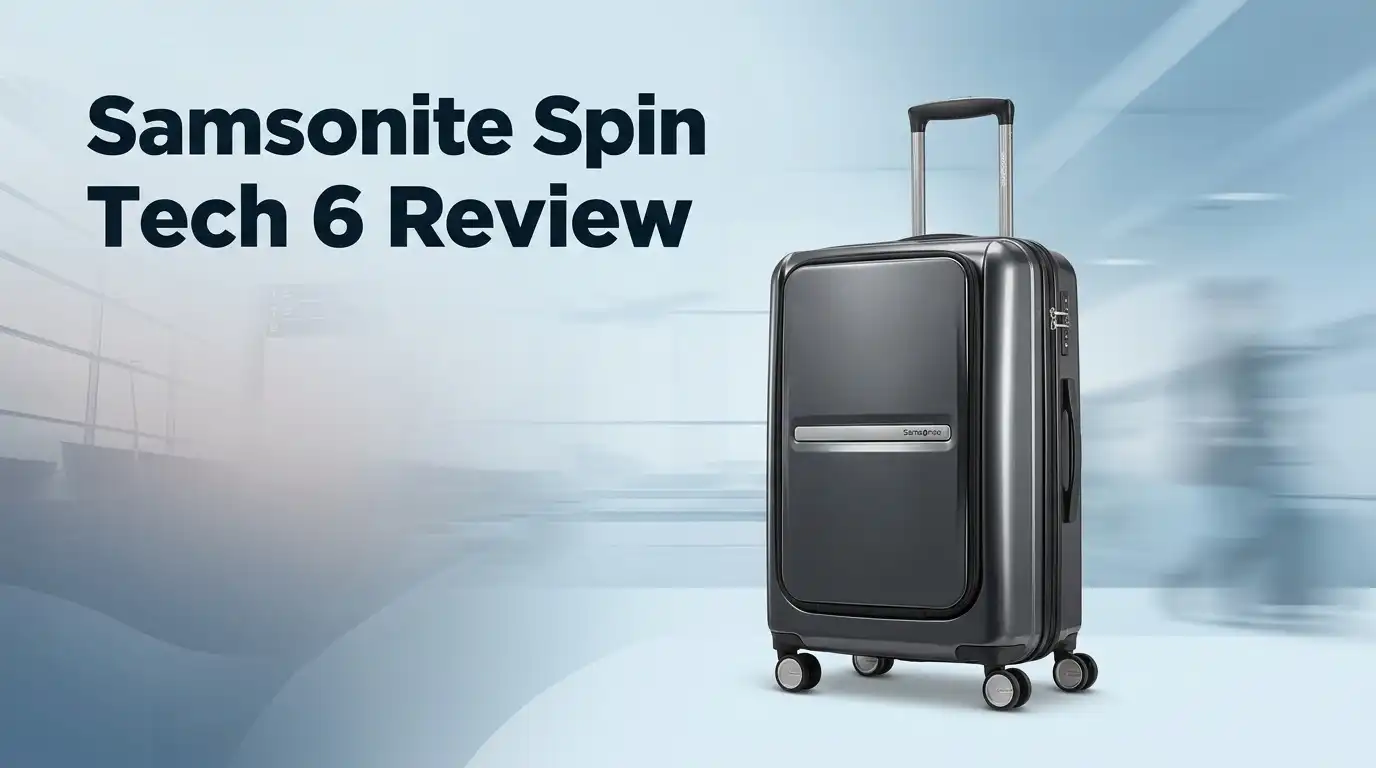
The Spin Tech 6 is a hardside spinner collection built around one idea: maximum suitcase for minimum money. It sells mainly through department store channels, often as an exclusive collection, which explains the huge gap between list price and sale price.
The lineup includes a carry on spinner near 22.5 inches tall, a medium check in spinner, and a large check in spinner around 31 inches tall. You can buy pieces alone or as a set. Colors rotate often, and shoppers see everything from plain black to copper, teal, and blush.
Every piece uses a textured hardshell, four dual spinner wheel assemblies, a telescoping handle with multiple stops, and a built in TSA accepted combination lock. The carry on adds an integrated charging port. All pieces expand roughly 1.5 inches for extra volume.
The “6” in the name simply marks the generation. Spin Tech 5.0 came before it. Version 6 brought a cleaner shell pattern, redesigned wheel hubcaps, and softer touch points on the handle grip. The changes are refinements, not reinventions.
Think of this collection as the department store cousin of Samsonite’s Freeform and Winfield lines. It shares the same design language and the same 10 year limited warranty structure, yet it targets a lower price shelf. That positioning matters a lot in the sections ahead.
Unboxing the Samsonite Spin Tech 6
My box arrived bruised at one corner, which made me nervous. The suitcase inside was fine. Samsonite ships these pieces in a thin cardboard sleeve with a plastic bag over the shell and small plastic caps over the wheels.
The first thing I noticed was the smell. New hardside luggage carries a faint plastic odor. It faded after two days with the bag open in a spare room. Do not pack fresh laundry into it on day one.
Next came the weight, or the lack of it. I lifted the carry on with one hand and my arm shot up faster than expected. The large check in piece weighs around 11 pounds, which sounds heavy until you compare it to older hardside luggage in the same size class.
Inside, I found a printed warranty card, a sticker sheet with lock instructions, and a small tag hanging from the handle. The TSA lock ships set to 0 0 0. Changing the combination took me about 40 seconds using a pen tip.
The shell finish looked better in person than in product photos. The texture hides fingerprints well. Two tiny scuff marks already sat near the bottom rail, likely from the factory. Nothing structural, but worth mentioning since some buyers expect showroom perfection.
Samsonite Spin Tech 6 Carry On Spinner Tested


Last update on 2026-09-24 / Affiliate links / Images from Amazon Product Advertising API
The carry on measures roughly 22.5 inches tall by 14.5 inches wide by 9.5 inches deep with wheels included. That puts it right at the edge of the classic 22 by 14 by 9 sizer box used by many United States carriers.
I flew it twice. Both times it slid into the overhead bin wheels first with room to spare. Both times I kept the expansion zipped closed. Expanded, it will likely fail a strict gate agent’s sizer, especially on budget airlines in Europe.
Packing surprised me. I fit five shirts, two pairs of jeans, a hoodie, seven days of socks and underwear, a toiletry bag, and a pair of sneakers. The compression straps did real work here. The zip pouch on the lid swallowed cables and chargers.
The charging port sits near the top corner of the shell. You plug your own battery into a short internal cable, then charge your phone from the outside. It works, though the flap covering the port feels flimsy.
Rolling through a long terminal was easy. The bag tracked straight beside me without drifting. Pulling it behind me on a broken sidewalk was noisier, and the small wheels caught on a few cracks. That is a hardside spinner problem in general, not a Spin Tech flaw.
Build Quality and Shell Material
The shell is a lightweight plastic composite with a textured, scratch resistant finish. Samsonite markets similar shells across its budget lines. Some Spin Tech pieces use polycarbonate, and others use a polypropylene blend depending on the production run and retailer.
I pressed hard on the center of the large piece. The panel flexed inward, then popped back with no crease. That flex is normal and even helpful, since a shell that bends absorbs impact better than one that cracks.
The corners carry small molded bumpers. They took the worst of my baggage claim abuse. After two flights, I counted three scuffs and one faint gray streak on the bottom rail. A damp cloth removed most of it.
Zippers are the weak link. They run smoothly, but the coils feel thin between the fingers. The main compartment uses a double zipper that accepts the TSA lock, and the pulls are metal rather than plastic, which helps.
The interior lining also shows the price point. It is a light polyester with visible stitching along the seams. Nothing frayed on me, though I would not trust it to survive rough handling for a decade.
Owner reports match my read. Most people describe the construction as sturdy and durable across international trips. A small minority report a snapped wheel or a failed zipper. That split is typical for luggage at this price.
Top 3 Alternative for Samsonite Spin Tech 6
Last update on 2026-09-24 / Affiliate links / Images from Amazon Product Advertising API
Samsonite Freeform Hardside Carry On Luggage

Last update on 2026-09-24 / Affiliate links / Images from Amazon Product Advertising API
Samsonite Winfield 3 DLX Hardside Expandable Luggage Set

Last update on 2026-09-24 / Affiliate links / Images from Amazon Product Advertising API
Samsonite Omni 2 Hardside 3 Piece Set
Wheels and Rolling Performance
Eight wheels, four corners. Each corner holds a dual wheel assembly that spins a full 360 degrees. This is the single best feature on the bag.
On smooth airport flooring, the carry on rolled with almost no push force. I nudged it with two fingers and it kept gliding. The large check in piece, loaded with about 40 pounds, still turned in place without tipping.
Noise stayed low. The redesigned hubcaps on version 6 seem to help, and several owners describe the wheels as quiet. Compared to older four wheel Samsonite models I have used, the difference is noticeable in a hotel hallway at 6 a.m.
Rough ground exposes the limit. Cobblestone, gravel, and cracked pavement stop these small wheels cold. I had to tilt the bag onto two wheels and drag it, which is harder with a spinner than with an inline roller.
The wheel housings attach with visible screws rather than rivets. That design means a damaged wheel can potentially be replaced instead of scrapping the bag. Samsonite service centers handle this under warranty terms, though turnaround varies.
One honest warning. Wheel failure is the most common complaint across the entire Spin Tech family. It does not happen to most buyers, but it happens often enough that I would register the warranty immediately after purchase.
Handle System and Comfort
The telescoping handle pulls up in one motion with a button release on the grip. My carry on offered three height stops. At 5 feet 10 inches, the tallest stop felt right. Taller travelers may want a fourth notch that does not exist.
The grip has a soft rubberized underside. Samsonite calls these refined touch points. In practice, it means your palm does not sit on bare plastic. After a 15 minute walk through a terminal, my hand stayed comfortable.
There is play in the handle tubes. Push the bag forward hard and the handle rocks slightly side to side. Every budget hardside suitcase does this. It bothers some buyers more than others, and it did not affect steering for me.
Side and top carry handles are molded plastic with a small rubber insert. They work for lifting the bag into a car trunk or an overhead bin. The top handle on the large piece sits a bit close to the shell, so gloved hands will struggle.
One design choice I liked: the handle tubes run outside the main compartment on the back panel. That keeps the interior floor flat, so you lose no packing space to a handle bump. Many competing bags at this price do the opposite.
Packing Space and Interior Layout
The Spin Tech 6 uses a clamshell design. Unzip the main compartment and the suitcase opens into two equal halves. One side holds elastic compression straps in an X pattern. The other side has a zippered divider panel with a mesh window.
The mesh window matters more than it sounds. You can see what sits behind the divider without unzipping anything. I kept dirty laundry on that side during my second trip.
Interior dimensions on the large check in piece run about 29 inches tall by 20 inches wide by 13.5 inches deep. That is genuinely cavernous. I fit two weeks of clothing plus shoes with room left over.
The compression straps are the unsung hero. Without them, a hardside bag lets clothes shift into a wrinkled pile. Cinched tight, my folded shirts arrived nearly presentable. Packing cubes make it even better.
There is also a small zip pouch sewn into the lid. It holds a passport, cables, and a charger. It is not big enough for a full toiletry kit.
What is missing? There is no dedicated laptop sleeve, no wet pocket, no shoe bag, and no exterior quick access pocket. Hardside shells rarely offer outside pockets, but a laptop sleeve inside the lid would have been an easy win.
Testing the 1.5 Inch Expansion
Every piece in the collection expands about 1.5 inches through a zipper that runs around the perimeter. Pull it and the shell pushes outward, adding real volume.
On the carry on, expansion added roughly 15 percent more space by my rough measure. I packed for four days closed, then repacked for seven days expanded. The extra depth swallowed a second pair of shoes and a jacket.
The expansion zipper feels sturdier than I expected. It uses a wider coil than the main compartment zipper. I zipped and unzipped it maybe 20 times with no snagging.
Here is the catch. Expanding the carry on likely pushes it past the standard 22 by 14 by 9 limit. Gate agents at United States legacy carriers rarely check. Budget carriers and most European airlines check often. Treat the expansion as a checked bag feature, or as a return trip feature after you buy souvenirs.
On the large check in piece, expansion pushes the packed weight dangerously close to the 50 pound airline limit. I hit 48 pounds without trying hard. A luggage scale is a smart accessory here, not a luxury.
USB Power Hub and Charging Port
The carry on includes an integrated charging port on the outside of the shell. This is one of the headline features Samsonite advertises for the collection.
Let me set expectations clearly. No battery is included. The port is a pass through. You place your own power bank inside a dedicated internal pocket, plug a short cable into it, and then charge your phone from the outside port.
That design is actually the right call. Airlines prohibit built in lithium batteries in checked bags, and removable power banks must travel in the cabin. A pass through port keeps the bag compliant everywhere.
In use, it worked fine. I charged my phone while waiting at the gate without opening the suitcase. The cable inside is short, so a large power bank sits awkwardly.
The flap over the exterior port is my complaint. It is a thin rubber cover that does not close tightly. After a few weeks, mine stayed slightly open. Dust and rain could reach the connector over time.
If you never carry a power bank, ignore this feature entirely. It adds no weight and no cost. If you do carry one, it is a small daily convenience that you will use more than you expect.
TSA Accepted Lock and Security
Each piece has a recessed three dial combination lock built into the shell. The lock is TSA accepted, which means airport screeners in the United States can open it with a master key instead of cutting it.
Setting the code took under a minute. You hold the reset button with a pen tip, spin the dials to your chosen number, and release. The dials click firmly and do not drift on their own.
A combination lock is a deterrent, not real security. Three dial locks can be opened by a determined person with time and patience. Never pack passports, jewelry, medication, or electronics in a checked bag and assume the lock protects them.
The lock secures the main compartment double zipper only. The expansion zipper and the front shell stay unsecured, which is standard.
One practical tip: write your code somewhere safe. Resetting a forgotten combination on these locks means trying up to 1,000 combinations by hand, and I have done that once. It took 25 minutes of my life that I will never recover.
Weight, Size, and Airline Rules
Weight numbers for this collection look good. The carry on lands near 7 to 8 pounds depending on the year and shell material. The large check in piece sits around 11 pounds.
Compare that to the checked bag allowance. Most airlines cap checked bags at 50 pounds. An 11 pound empty suitcase leaves you 39 pounds of packing room, which is generous for a bag this large.
Carry on sizing needs care. At 22.5 inches tall including wheels, the carry on exceeds the strict 22 inch height limit by half an inch. In practice, the bag fits standard sizer boxes and overhead bins because the wheels compress slightly and agents measure loosely.
I would not fly this bag as a carry on with Ryanair, Wizz Air, or similar ultra low cost carriers. Their sizers are unforgiving and their fees are painful.
For domestic United States travel, Delta, American, United, Southwest, and Alaska all accepted it without comment during my trips and in owner reports. Your mileage may vary with a strict agent on a full flight.
What the Spin Tech 6 Does Not Do Well
Honest reviews name the flaws, so here they are.
The shell scuffs. Textured finishes hide fingerprints, but baggage handlers leave gray marks along the bottom rail. Mine looked used after two flights. Lighter colors show it less than black.
The handle wobbles. Not badly, but you feel it. Premium bags in the $300 and up range use thicker tubes with tighter tolerances.
The zippers feel thin. They worked fine for me, yet they are the component I would expect to fail first. Owner complaints support that concern.
Wheels are the known failure point. A minority of buyers report a wheel cracking or seizing within the first year. Registering the warranty and keeping the receipt matters.
No laptop sleeve or exterior pocket. You will open the whole bag to reach anything.
Expansion kills carry on compliance. Useful on checked pieces, risky on the carry on.
The charging port flap is weak. Minor, but it loosened within weeks.
Finally, the pricing is confusing by design. A list price near $500 marked down to $150 is a retail tactic. Judge the bag as a $150 suitcase, because that is what it is. At that price it performs well. At $500 it would not be competitive at all.
Pros and Cons
Pros
- Dual 360 degree spinner wheels roll smoothly and quietly, even when the bag is fully packed
- Very light for its size, with the large check in piece near 11 pounds
- Huge interior volume, plus 1.5 inches of expansion for longer trips
- Compression straps and a zippered divider keep clothes flat and organized
- TSA accepted combination lock is built in and easy to set
- Integrated charging port on the carry on adds real convenience for power bank users
- Textured shell resists fingerprints and hides light scratches
- Backed by a 10 year limited warranty from an established brand
- Frequently discounted to between $80 and $160, which is excellent value
- Wide color selection, including bold shades that are easy to spot at baggage claim
Cons
- Zippers feel thinner than the shell quality suggests
- Telescoping handle has noticeable side to side play
- Wheel failures appear in a small but real share of owner reports
- Bottom rail scuffs quickly, especially on dark colors
- No laptop sleeve, no wet pocket, and no exterior quick access pocket
- Expanded carry on may exceed strict airline sizers
- Small wheels struggle badly on cobblestone and gravel
- Charging port flap loosens with use
- List prices are inflated, which makes value comparisons harder
- Interior lining is basic and would not survive heavy long term abuse
Price and Value in 2026
This is where the Spin Tech 6 earns its recommendation. The collection carries list prices between roughly $300 and $500 per piece. It almost never sells there.
Through 2026, I tracked the carry on between $80 and $160. Retailers ran promotions at 60 to 80 percent off repeatedly. Large check in pieces appeared near $159. Two piece and three piece sets showed up under $250 during holiday events.
At those real prices, the value is strong. A lightweight hardside spinner with a TSA lock, expansion, and eight smooth wheels for $100 is a genuine bargain. Competing bags at that price often use single wheels and skip the lock.
Do not pay close to list price. If you see the carry on above $200, wait. Sales cycle through several times a year, usually around major retail holidays.
Compare the alternatives honestly. The Samsonite Freeform carry on costs more and uses a tougher polypropylene shell with a better warranty experience. The Winfield 3 DLX sits in similar territory with a polycarbonate shell. The Omni 2 offers a stronger reputation for durability at a modest premium.
If your budget stretches to $180 or more, those alternatives buy you better zippers and thicker handle tubes. If your budget is firm at $100, the Spin Tech 6 is hard to beat.
Who Should Buy the Samsonite Spin Tech 6?
Buy this bag if you travel a few times a year. Two or three trips annually will not stress the components enough to reach their limits. You get modern features and smooth wheels for a fraction of premium pricing.
Buy it if you need a large checked bag on a budget. The 31 inch piece offers enormous volume at 11 pounds, and the value at $160 is excellent.
Buy it if you are building a first luggage set. Families and students get the most out of multi piece discounts here.
Skip this bag if you fly weekly. Frequent flyers wear out zippers and wheels fast. Spend more on a Samsonite Omni 2, a Travelpro Platinum Elite, or a similar bag built for high mileage.
Skip it if you travel through old European city centers regularly. Small spinner wheels and cobblestone are a bad match. A two wheel roller with larger wheels handles that terrain better.
Skip it if you need laptop access on the go. There is no sleeve and no exterior pocket, so you will be unzipping the whole suitcase at the gate.
Skip it if you demand a flawless finish. This shell picks up marks. If that will bother you every trip, buy something with a matte ribbed surface instead.
Final Verdict
The Samsonite Spin Tech 6 is a good suitcase at a great price and an average suitcase at full price. That single sentence sums up the whole review.
The wheels genuinely impressed me. The weight to volume ratio is excellent. The expansion works. The lock works. The interior organization is smarter than the price suggests.
The zippers, the handle play, and the scuff prone shell remind you what you paid. Nothing broke during my testing, but I can see where wear would appear after several years of regular use.
My rating is 4 out of 5 at sale prices, and 2.5 out of 5 at list prices. Wait for a discount. They come often.
If you want more durability and can spend another $60 to $100, look at the Samsonite Freeform or Omni 2. Both feel a step up in hardware quality. If you want maximum suitcase for minimum money and you travel occasionally, the Spin Tech 6 deserves a spot on your shortlist.
Frequently Asked Questions
Is the Samsonite Spin Tech 6 carry on airline approved?
The carry on measures about 22.5 by 14.5 by 9.5 inches with wheels. It fits standard United States carrier bins and sizers without issue when the expansion stays closed. Strict budget airlines in Europe and Asia may reject it, especially if expanded.
How much does the Spin Tech 6 weigh?
The carry on weighs roughly 7 to 8 pounds. The large check in piece weighs about 11 pounds. Exact figures shift slightly between production years and shell materials.
Does the Spin Tech 6 come with a battery?
No. The carry on has an integrated charging port, but you supply your own power bank. This design keeps the bag compliant with airline lithium battery rules.
What warranty does Samsonite offer on the Spin Tech 6?
Samsonite backs the collection with a 10 year limited warranty covering manufacturing defects. Normal wear, airline damage, and cosmetic scuffs are not covered. Register your purchase and keep the receipt.
Is the shell polycarbonate or polypropylene?
It varies by production run and retailer. Some Spin Tech 6 pieces use polycarbonate, and others use a polypropylene blend. Both resist scratching reasonably well and flex under impact rather than cracking.
Can I replace a broken wheel?
Yes, in many cases. The wheel housings attach with screws, and Samsonite service centers can supply replacements. Warranty coverage depends on whether the failure counts as a defect or as airline damage.
Is the Spin Tech 6 better than the Samsonite Freeform?
The Freeform generally uses a tougher shell and slightly better hardware, and it costs more. The Spin Tech 6 wins on price and on interior volume. For occasional travel, the Spin Tech 6 is the better value. For frequent travel, choose the Freeform.
How many days can I pack in the carry on?
Four to five days easily without expanding. Seven days when expanded and using packing cubes. The compression straps make a real difference in how much fits.
Does the expansion make the bag unstable?
No. Expanded, the shell holds its shape and the wheels still track straight. The real risk is weight, since an expanded large piece reaches airline limits quickly.
Where can I buy the Spin Tech 6?
It sells mainly through department store channels as an exclusive collection, with Amazon carrying closely related Samsonite hardside spinners. Prices swing widely, so compare before buying and wait for a promotion.

Hi, I’m Luna Beck — the founder and voice behind Urban Pack Vault. I’m passionate about helping people find bags that perfectly match their lifestyle. From backpacks to travel luggage, I research, review, and recommend so you never have to second-guess your next purchase.