How Many Liters Is a Standard School Backpack?
A school backpack can look normal on the outside and still feel wrong every morning. One bag may seem too small once the lunch box goes in.
Another may feel too big and pull on the shoulders. That is why the real question is not just about style or shape. The real question is capacity.
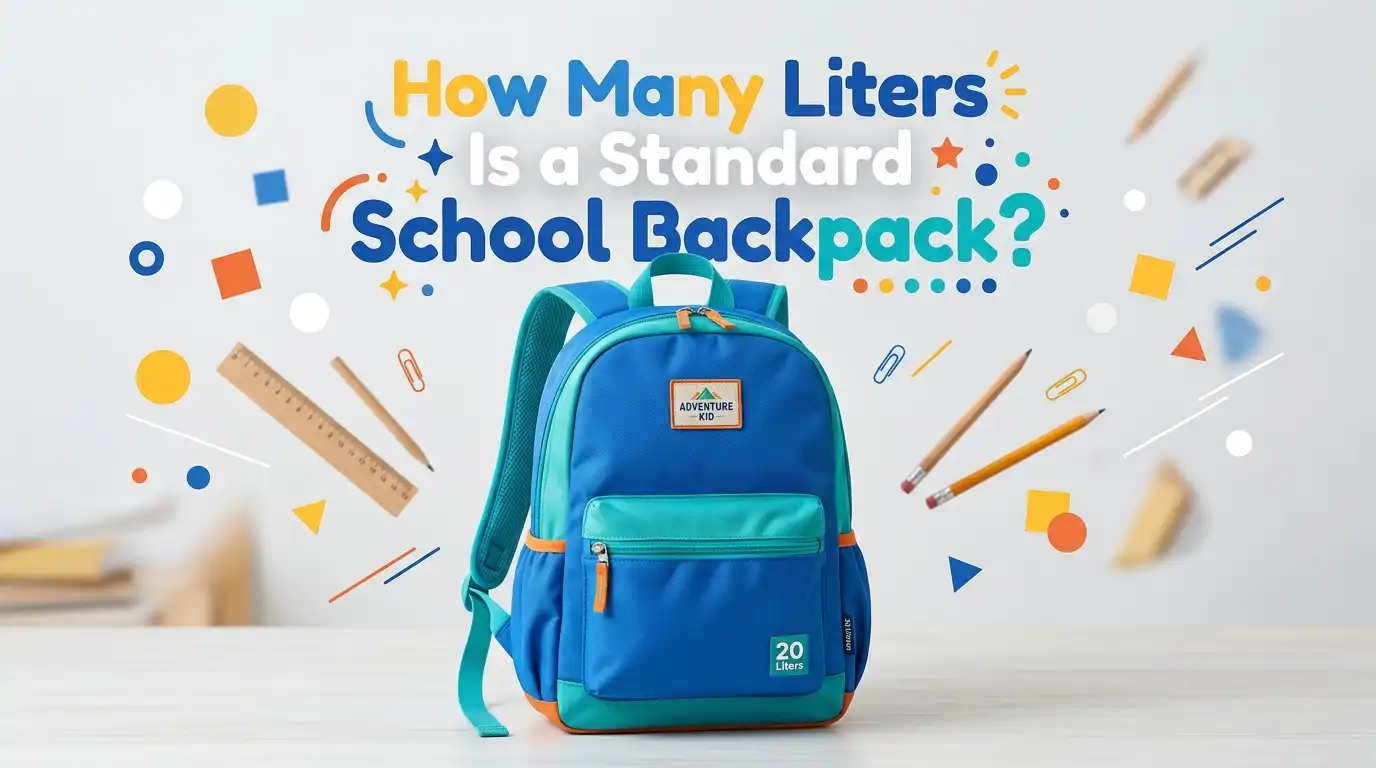
If you have ever asked how many liters a standard school backpack is, the short answer is this: most standard school backpacks fall in the 20 to 30 liter range, and many everyday student bags sit close to 24 to 25 liters.
Key Takeaways
- A standard school backpack is usually 20 to 30 liters. In real life, many common school bags land near 24 or 25 liters. That size works for folders, notebooks, a lunch box, a water bottle, and a light jacket. It gives enough room for daily school use without feeling too bulky.
- Younger students often need less space. A smaller child may do well with 15 to 20 liters if the school load is light. Many grade school students still move up to 20 to 24 liters once they carry full size folders, library books, and extra supplies. Size should match the child, not just the grade.
- Older students often need more room. Middle school and high school students may need 24 to 32 liters, especially if they carry binders, a laptop, or gym clothes. A larger bag can help, but only if the student truly uses the space. Extra room often turns into extra weight.
- Bag weight matters as much as bag size. A child should not carry a backpack that is too heavy for their body. A common safety tip is to keep the loaded backpack at or under about 15 percent of body weight. Even the right liter size can become a problem if the bag is overpacked.
- You can measure backpack volume at home. Use height, width, and depth in centimeters. Multiply them, then divide by 1000. This gives a rough liter estimate. It is not perfect because pockets and shape affect the final number, but it is a very useful starting point.
- The best backpack is the one that fits the student and the school day. Think about books, laptop size, lunch, water bottle, and after school items. Then choose the smallest size that fits everything well. That simple rule solves most backpack size mistakes.
What Is a Standard School Backpack in Liters
When people say standard school backpack, they usually mean a bag for normal daily classes, not a tiny preschool bag and not a large travel pack. Current online size guides and school backpack listings show that this standard zone usually sits between 20 and 30 liters.
Inside that range, many common student bags fall close to 24 or 25 liters. That size often fits one or two binders, several notebooks, a pencil case, a lunch box, and a water bottle. It also leaves room for a hoodie or a small tablet.
A bag under 20 liters can work for light school days. A bag over 30 liters can work for teens with more gear. Still, for the average student, 20 to 24 liters is the safest place to start. It feels practical, simple, and easier to carry all day.
Why Most Students Fit Best in 20 to 24 Liters
A 20 to 24 liter backpack hits a sweet spot for many students. It is large enough for daily items, but it usually does not feel huge on the back. That balance is the main reason this size range shows up again and again in school backpack guides and common product sizes.
A student with regular class supplies often needs space for folders, notebooks, a planner, lunch, and a bottle. Twenty to 24 liters handles that load well. It also helps the student stay organized because the bag is big enough for essentials but small enough to discourage random clutter.
Pros: This size feels easier to manage, fits many school needs, and works for a wide age range.
Cons: It may feel tight if the student carries large sports gear, thick textbooks, or a big laptop.
If you want one simple answer, this is often it: a standard school backpack is usually around 24 liters.
How Backpack Size Changes by Age and Grade
Backpack size should change as school demands change. A first grader and a high school student do not carry the same load, so they should not always carry the same volume. This is where many parents make a simple but costly mistake.
Younger children often need a smaller and shorter bag that matches their body. Many do well in the 15 to 20 liter range if school items are light. Once full size folders and take home books show up, many kids move into 20 to 24 liters.
Middle school students often need more organization and more space. That pushes many of them into 24 to 28 liters. High school and college students may need 24 to 32 liters, especially with a laptop and charger.
The key idea is simple: grade matters, but body size and daily load matter more. A smaller teen may need less volume than a tall elementary student with heavy folders.
How to Measure a Backpack in Liters at Home
If the label is missing, you can still estimate backpack volume at home. This method gives a rough answer, and it is good enough for daily buying decisions. You only need a tape measure and a calculator.
Measure the main body of the backpack in centimeters. Record the height, width, and depth. Then multiply those numbers. After that, divide the result by 1000. The final number is the rough liter estimate.
For example, if the bag is 45 centimeters tall, 30 centimeters wide, and 15 centimeters deep, the math is 45 x 30 x 15. That equals 20250 cubic centimeters. Divide by 1000, and you get about 20.25 liters.
Pros: Fast, free, and easy to do at home.
Cons: It may miss curved shapes, side pockets, and extra compartments.
Still, this method is a smart way to check whether a backpack is truly small, medium, or large.
How Much Space Common School Items Really Need
Many backpack problems happen because people guess instead of counting the actual items. A better method is to look at what the student carries each day. That makes the liter question much easier to answer.
A few notebooks and folders do not take much room. A lunch box, water bottle, pencil case, and sweatshirt add more bulk than many people expect. A laptop also changes the size choice fast, especially if it is 15 inches or larger.
A light daily load may fit inside 18 to 20 liters. A normal school load with lunch and a bottle often needs 20 to 24 liters. A fuller day with a laptop, charger, art supplies, or gym clothes may need 24 to 30 liters.
Pros of item counting: It is realistic, personal, and easy to repeat.
Cons of item counting: It takes a few minutes and may miss special event days.
If you want the best answer, lay out the items first. The backpack should fit the load, not the guess.
How to Choose the Right Size for Elementary School
Elementary school students need a bag that is useful without being overwhelming. Many young children carry fewer supplies than older students, but they still need room for full size papers, a lunch box, and extra clothes on some days.
For lighter school use, 15 to 20 liters can work well. This size feels easier on a small frame and helps prevent overpacking. Once the child starts carrying folders, library books, art work, or a larger lunch bag, 20 to 24 liters often becomes the better fit.
Pros of a smaller bag: Less bulk, lighter feel, and better fit on shorter backs.
Cons of a smaller bag: It can run out of space fast during busy school weeks.
Pros of a medium bag: More flexible and useful across more school years.
Cons of a medium bag: It can invite extra weight if the child fills every pocket.
For many elementary students, 20 liters is a practical starting point.
How to Choose the Right Size for Middle School
Middle school is often the turning point for backpack size. Students carry more notebooks, larger binders, and sometimes a device. They also move between more classes, so organization matters as much as pure space.
This is why many middle school students do best in the 24 to 28 liter range. That size usually handles daily school supplies, lunch, a water bottle, and a hoodie without feeling too cramped. If the school uses laptops or tablets often, the bag should also include a padded sleeve.
Pros of 24 to 28 liters: Strong balance of space and comfort, good for growing students, and enough room for changing schedules.
Cons: It may feel too large for a smaller child or too small for sports days.
A bag under 20 liters may feel too limiting here. A bag over 30 liters can work, but only if the student truly needs the space. Most middle school students do not need a huge backpack.
How to Choose the Right Size for High School and College
High school and college students often carry the widest mix of items. Books may be fewer in some schools, but laptops, chargers, headphones, folders, snacks, and gym clothes quickly take up space. This is why many older students use bags between 24 and 32 liters.
If the student carries a laptop every day, start near 24 to 28 liters. If they also carry sports gear, lab items, or long day supplies, go closer to 28 to 32 liters. A very large bag can help, but only if it stays organized and does not become a dumping zone.
Pros of a larger student bag: Better for long days, tech gear, and after school needs.
Cons: More room often means more weight, more clutter, and more shoulder strain.
The goal is not the biggest backpack. The goal is the smallest backpack that still handles the busiest normal day.
Pros and Cons of Small Medium and Large Backpack Sizes
Backpack liters are easier to understand when you break them into size groups. A small backpack is often under 20 liters. A medium backpack usually sits around 20 to 30 liters. A large school backpack often starts around 30 liters.
Small size pros: Light, simple, and easy to fit on smaller students.
Small size cons: Tight fit for lunch, folders, and extra clothes.
Medium size pros: Best all around choice, good for daily school items, and easier to organize.
Medium size cons: May still feel crowded on sports days or tech heavy days.
Large size pros: Better for older students, big loads, and long schedules.
Large size cons: Easier to overpack, heavier to carry, and sometimes too long for the back.
For most families, medium is the safest answer. It solves more problems than small and creates fewer new problems than large.
How to Match Backpack Liters to Laptop Lunch and Sports Gear
A backpack can feel big enough until one extra item changes everything. That is why you should match liter size to the most space hungry items first. In most cases, those items are the laptop, lunch container, and sports or band gear.
A compact school day with no laptop may fit into 20 to 22 liters. Add a lunch box and water bottle, and 22 to 24 liters feels safer. Add a 15 inch laptop, charger, and over ear headphones, and 24 to 28 liters becomes more realistic. Add shoes or gym clothes, and many students need 28 to 32 liters.
Pros of this method: Very practical, easy to check, and based on real use.
Cons: It can push you to buy bigger than needed if sports gear is only carried once in a while.
A smart fix is to size for the usual day, then use a second small bag for rare extra gear.
How to Tell if a Backpack Is Too Big or Too Small
You can often tell a backpack problem before anyone measures liters. A bag that is too small looks stuffed, pulls zippers tight, and forces papers to bend. A bag that is too big hangs low, shifts while walking, and invites the student to carry things they do not need.
A loaded backpack should sit close to the body and rest around the middle of the back. It should not sag far below the waist area. If the student leans forward to balance the load, the bag is too heavy, too big, or packed the wrong way.
Signs the bag is too small: No room for lunch, bent folders, broken zippers, and items clipped outside.
Signs the bag is too big: Empty dead space, sloppy load shift, and daily overpacking.
The right bag feels boring in the best way. It fits the stuff, stays balanced, and does not demand attention all day.
A Simple Step by Step Formula to Pick the Right Backpack
If you want a clear answer without overthinking, use this simple method. It works for most students and makes backpack shopping much easier.
First, lay out everything the student carries on a normal school day. Include books, folders, lunch, bottle, tech, and one extra layer. Second, decide whether that load is light, normal, or full. Third, match the load to a size band.
Use 15 to 20 liters for a light load on a smaller student. Use 20 to 24 liters for a normal daily load. Use 24 to 32 liters for a full load with laptop, lunch, and activity items. Then check body fit. The bag should sit close, feel balanced, and not look oversized.
Pros of this formula: Fast, realistic, and easy to repeat next year.
Cons: It still needs common sense for very small or very tall students.
For most families, this is the easiest path to the right answer.
FAQs
Is 20 liters enough for school?
Yes, 20 liters is enough for many students, especially in elementary school or on light school days. It usually works for notebooks, folders, a pencil case, and a lunch box. It may feel tight if the student carries a large laptop, gym clothes, or bulky winter items.
Is 30 liters too big for a school backpack?
Not always. A 30 liter bag can be a good choice for older students, long school days, or students with sports gear. It can feel too large for a smaller child or a student with a light daily load. The biggest risk is overpacking.
What is the most common school backpack size?
A very common everyday size is around 24 to 25 liters. That size often gives enough room for school basics without feeling oversized. It is one of the most practical choices for general student use.
How heavy should a loaded school backpack be?
A useful safety rule is to keep the loaded backpack at or under about 15 percent of the student’s body weight. The bag should also sit close to the back and be worn with both shoulder straps. Good fit matters just as much as weight.
Can I use dimensions instead of liters?
Yes. If liters are not listed, measure the height, width, and depth in centimeters. Multiply those numbers and divide by 1000. That gives a rough volume estimate and helps you compare bags more easily.

Hi, I’m Luna Beck — the founder and voice behind Urban Pack Vault. I’m passionate about helping people find bags that perfectly match their lifestyle. From backpacks to travel luggage, I research, review, and recommend so you never have to second-guess your next purchase.