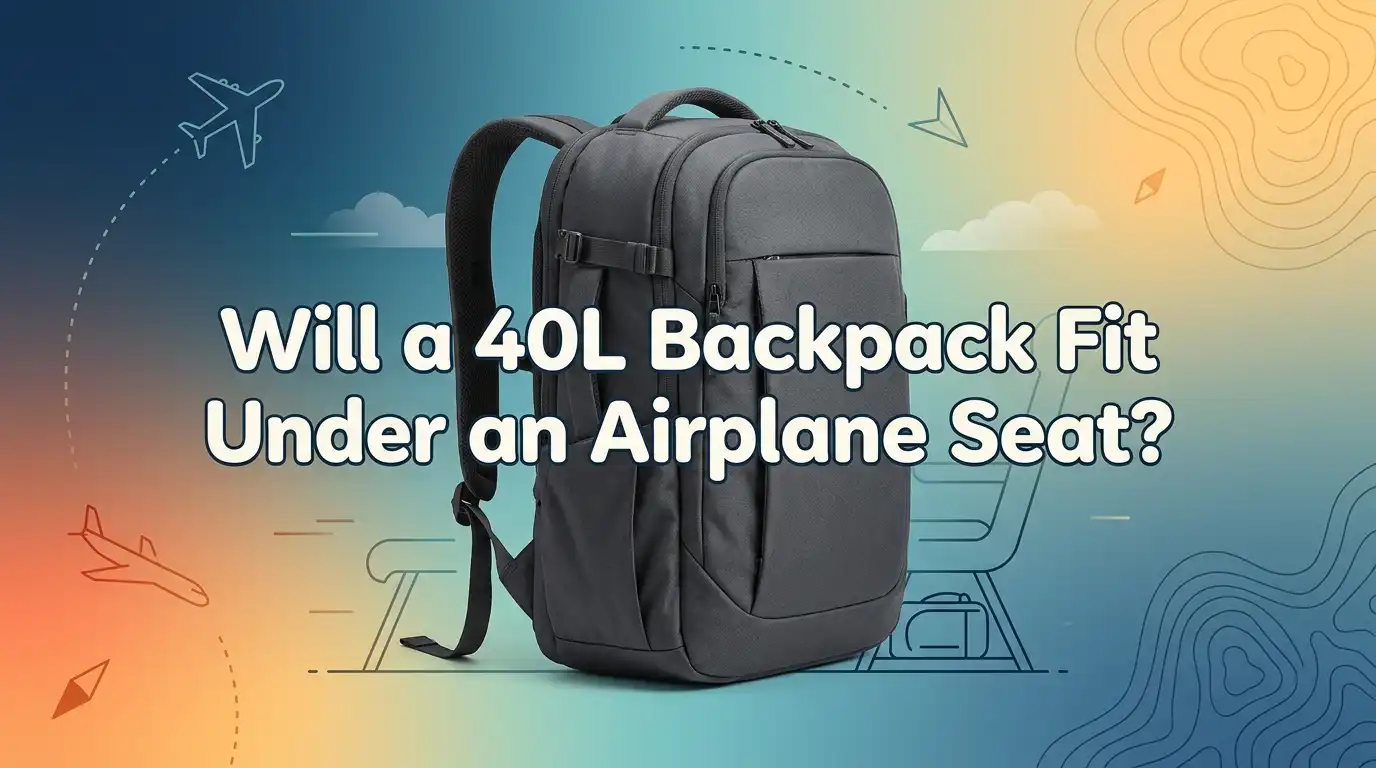
Will a 40L Backpack Fit Under an Airplane Seat?
If you travel with one bag, this question matters a lot. You want to skip bag fees, move fast, and keep your things close. But a 40L backpack sits in an awkward spot. It is often too big to feel like a small day bag, yet it can still look soft enough to squeeze under a seat.
That is where many travelers get stuck. The answer is not a simple yes or no. A 40L backpack can fit under an airplane seat in a few cases, but in many cases it will not fit safely or within airline rules.
The real answer depends on the bag shape, how full you pack it, the airline, the aircraft, and how strictly staff check size. This guide breaks it down in plain language and gives you clear steps you can use before your next flight.
In a Nutshell
- A 40L backpack usually sits closer to carry on size than personal item size. Most airlines expect a personal item to fit fully under the seat in front of you. Many 40L packs are built for overhead bin use, even if they look soft and flexible.
- Liters do not tell the full story. A 40L label tells you internal volume, but airlines check outside dimensions. Two bags can both be 40L and still fit very differently under a seat. A short and boxy bag may fail, while a softer and flatter one may pass.
- The depth of the bag matters most. Height and width matter, but a thick bag is what usually causes trouble. If your backpack bulges too far out, it can block leg space and fail the underseat test. That is why careful packing helps more than most people think.
- Airline rules vary a lot. Some airlines allow a fairly small personal item. United lists 9 x 10 x 17 inches. JetBlue lists 17 x 13 x 8 inches. American lists 18 x 14 x 8 inches. Frontier lists 14 x 18 x 8 inches. easyJet allows 45 x 36 x 20 cm. Those numbers show why many full 40L bags struggle as underseat bags.
- Soft bags give you a better chance than rigid bags. A soft backpack with compression straps and no hard frame can sometimes work if it is underpacked. The upside is flexibility. The downside is comfort loss, less legroom, and a higher chance that staff will ask you to move it to the overhead bin.
- The safest move is simple. If your goal is true underseat travel on most airlines, aim lower than 40L. If you already own a 40L bag, measure it, pack it shallow, wear bulky layers, and be ready with a backup plan. That plan may be overhead storage, gate check, or repacking into a smaller personal item.
The short answer most travelers need
For most flights, a 40L backpack is not the safest choice for underseat storage. It is usually better viewed as a carry on bag, not a personal item. That does not mean it will fail every time. A soft 40L bag that is only partly full may squeeze under some seats.
Still, you should not plan around luck. If the bag is packed full, the odds drop fast. Many personal item limits sit around 17 to 18 inches long, 13 to 14 inches wide, and 8 inches deep. A full 40L pack often pushes past those numbers in at least one direction.
The main benefit of trying is that you may keep everything at your feet. The drawback is stress at the gate, less legroom, and the risk of being told to move the bag or pay. If you want the simple truth, treat 40L as overhead size first and underseat size only in special cases.
Why 40L sounds smaller than it really is
A lot of confusion starts with the word liters. Liters measure internal volume. Airlines do not care about volume first. They care about outside dimensions. That is why a 40L backpack can fool people. It sounds moderate, but it can still be large in the wrong places.
A 40L backpack often lands near the upper end of cabin travel bags. Many are shaped to match common carry on limits, not underseat limits. That means they may be tall enough and wide enough for cabin travel, but still too deep or too long for the space below the seat.
The upside of volume based shopping is that it helps you compare capacity. The downside is that it hides the part airlines actually enforce. A smart traveler checks inches or centimeters first and liters second. If you only remember one rule from this guide, remember that one.
What airlines mean by a personal item
Airlines usually call a personal item something like a purse, laptop bag, briefcase, or small backpack. The key test is simple. It must fit under the seat in front of you. That is the part that matters more than the bag label.
Delta says a personal item should be similar in size to a purse, briefcase, laptop bag, or small backpack and must fit beneath the seat. United says personal items must fit under the seat and gives a limit of 9 x 10 x 17 inches.
American says a personal item must fit under the seat and stay within 18 x 14 x 8 inches. JetBlue says 17 x 13 x 8 inches. Frontier says 14 x 18 x 8 inches. easyJet allows one small underseat cabin bag up to 45 x 36 x 20 cm. Ryanair says one small personal bag of 40 x 30 x 20 cm must fit under the seat.
The good news is that airlines tell you the rule clearly. The bad news is that these limits are often smaller than a full 40L bag. That is why the personal item label should never be guessed. It must be checked before every trip.
Common airline size rules show the real problem
Here is the pattern that matters. Most personal item rules sit near a narrow range. United allows 9 x 10 x 17 inches. American allows 18 x 14 x 8 inches. JetBlue allows 17 x 13 x 8 inches.
Frontier allows 14 x 18 x 8 inches. Ryanair allows 40 x 30 x 20 cm. easyJet allows 45 x 36 x 20 cm. Delta requires the bag to fit under the seat but does not publish one standard personal item size on the main carry on page.
Those numbers matter because a typical 40L travel backpack often pushes close to common carry on dimensions, which are much larger than many personal item rules. That gap is the whole issue. A bag may be legal for the cabin and still fail as an underseat item.
The benefit of checking airline rules is that you can plan with facts. The drawback is that rules vary by airline and even by aircraft. So the best method is to use the strictest limit on your trip, not the most generous one.
How to measure your backpack the right way
If you want a real answer, measure your backpack before you leave home. Do not trust the product page alone. Bags change shape when packed. Grab a tape measure and fill the bag the way you plan to travel. Then measure height, width, and depth at the widest points.
Be honest about bulges. A laptop sleeve, shoes, or a packed jacket can add more depth than you expect. Also count straps, handles, and outside pockets if they stick out. Airlines often include those parts in the final size check.
Pros of this method: it is simple, cheap, and accurate enough for travel planning.
Cons of this method: it still cannot predict every aircraft seat shape or every gate agent decision.
If your bag is over by even one inch, do not assume it will be fine. A soft bag may compress. A full bag may not. Measuring at home gives you the best shot at a calm airport experience.
Depth is the deal breaker under the seat
Most travelers focus on height first, but depth is often the real problem. A tall bag can sometimes slide in sideways or angle down. A deep bag has far less room to hide. It pushes into your leg space and catches the front edge of the seat area fast.
That is why many 40L backpacks fail even when they look close on paper. The bag may be soft enough to bend a little, but once it is packed full, the front panel becomes thick and rounded. That makes the bag feel much bigger than its listed size.
A flatter bag has a better chance than a boxy bag. That is useful if your 40L backpack opens like a suitcase. You may be able to spread items more evenly and avoid one large bulge. The trade off is that you may need to pack less, and that can defeat the reason you chose 40L in the first place.
How to pack a 40L bag so it has a chance
If you must try using a 40L backpack under the seat, pack for shape, not just space. Put flat items against the back panel. Keep shoes, bulky layers, and round objects out of the center if possible. Use every compression strap. Avoid stuffing the front pocket with chargers and snacks until it balloons outward.
A smart order helps. Put your laptop or folder flat. Add clothing cubes that stay soft. Place small items in gaps, not on the outside face. Leave a little empty space at the top so the bag can compress. Do not pack to the zipper line if underseat fit is your goal.
Pros: you improve your odds without buying a new bag.
Cons: you lose some capacity, and the bag may still fail on a strict airline.
This method works best for travelers who can live out of fewer clothes and who do not need to fill every liter just because the space is there.
Compression works, but only up to a point
Compression straps, packing cubes, and softer clothing can make a big difference. They help reduce depth and keep the bag from turning into a round lump. A soft sided 40L backpack with strong compression can pass more easily than a structured 40L bag with a rigid frame.
Still, compression is not magic. It can control shape, but it cannot erase too much size. If your bag starts far above the airline limit, straps alone will not save it. They help most when the bag is just a little over and you are willing to underpack.
Pros of compression: better shape control, cleaner fit, less sag, and easier sliding under the seat.
Cons of compression: wrinkled clothes, less quick access, and lower packing comfort.
Think of compression as a finishing tool, not a rescue tool. It helps a borderline bag. It does not turn a clearly oversized 40L bag into a guaranteed personal item.
Aircraft type changes the answer
Even if your backpack passes the airline rule on paper, the seat space can still change. Regional jets often have tighter underseat space. Exit rows and bulkhead rows can also change the storage situation. On some flights, you may have to place your personal item in the overhead bin during takeoff or landing.
This is why some travelers say their 40L bag fit once and failed the next time. They are both telling the truth. The aircraft was likely different, or the bag was packed differently. Underseat fit is never just about one number. It is about the real seat in front of you.
The upside of knowing this is that you can plan better. The downside is that you cannot control every aircraft swap. If your trip includes small regional flights, the safer move is to assume less underseat space, not more.
Personal item or carry on which is the smarter plan
If your 40L backpack fits most carry on rules, treating it as a carry on is usually the lower stress choice. That gives you more room to pack and less pressure to flatten the bag. You also keep your foot space open, which makes the flight more comfortable.
Trying to use it as a personal item has one clear appeal. You may avoid extra fees on strict airlines or pair it with a second cabin bag on airlines that allow both. But that only works if the backpack truly fits the personal item rule.
Personal item approach pros: possible fee savings, quicker exit, all gear close to you.
Personal item approach cons: stricter size checks, less legroom, more repacking stress.
Carry on approach pros: easier fit, fuller packing, less gate tension.
Carry on approach cons: overhead space can fill up, and some basic fares charge more.
For most people, 40L works better as a carry on than as an underseat bag.
What to do if staff question your bag at the gate
If a gate agent looks at your backpack and seems unsure, stay calm. Your goal is to solve the problem fast. Loosen your shoulder straps so the bag looks flatter. If the airline uses a sizer, place the bag in gently and let the soft sides settle. Do not argue before you try.
Have a backup plan ready. Move a jacket, charger pouch, or toiletry bag into your pockets or a small tote if allowed. Taking out one or two bulky items can reduce depth fast. If you know the bag is close, this can make the difference.
Pros of a backup plan: less stress, faster fix, better chance of boarding smoothly.
Cons of a backup plan: a little hassle at the gate and some last minute reshuffling.
The worst move is surprise. The best move is arriving with a plan B already in your head.
The most reliable size if you want true underseat travel
If your goal is underseat certainty on most airlines, 40L is too ambitious for many trips. A smaller backpack is usually the safer answer. Many travelers find the sweet spot in the personal item range by choosing a bag that stays close to the tighter airline limits, especially on depth.
That does not mean 40L is a bad size. It is a strong one bag size for overhead travel. It just asks for compromise if you want it under the seat. The closer you get to full 40L use, the less realistic underseat use becomes.
The upside of going smaller is simple travel and fewer gate worries. The downside is less packing space. But for short trips, a smaller bag often forces better packing choices. In real travel, that trade is worth it more often than people expect.
A simple step by step test before every flight
Use this quick test before you decide. First, check your airline personal item rule. Second, pack the backpack exactly as you will travel. Third, measure height, width, and depth at the widest points. Fourth, compare your packed size to the airline limit, not the empty bag size.
Fifth, ask one honest question. Can the bag still flatten if needed, or is it already at its limit? Sixth, think about your aircraft type if you know it. Seventh, decide now whether this bag is your personal item or your carry on. That choice should happen at home, not at the gate.
Pros of this system: clear, fast, repeatable, and low stress.
Cons of this system: it takes a few minutes and may force you to remove items.
A short test at home is far easier than a last second bag debate in a boarding line.
Final verdict on whether a 40L backpack will fit
A 40L backpack might fit under an airplane seat, but it usually depends on special conditions. The bag needs to be soft, lightly packed, shaped well, and used on an airline and aircraft with enough space. That is a lot of variables for something most travelers want to feel simple.
So here is the practical answer. If you already own a 40L bag, you can try to make it work by measuring it, packing shallow, and compressing it hard. But if you need a reliable underseat setup across many airlines, do not build your plan around a full 40L backpack.
Best case: it works and saves you stress later in the flight.
Worst case: it fails at the gate, steals your legroom, or turns into an overhead bag anyway.
For most trips, a 40L backpack is best treated as a carry on first and an underseat bag only when the numbers truly agree.
FAQs
Can a 40L backpack count as a personal item?
Sometimes, yes. In many cases, no. The label does not decide it. The packed outside dimensions decide it. If the bag stays within the airline personal item limit and fits under the seat, it can count. If it does not, it is a carry on or it may need to be checked.
Is a soft 40L backpack better than a structured one for underseat use?
Yes, in most cases. A soft bag can compress and change shape more easily. That gives you a better chance. A structured bag holds its shape, which is good for packing but worse for squeezing into tight underseat space. Soft helps, but it still does not beat a strict size rule.
Which part of the backpack matters most for underseat fit?
Depth matters the most for many travelers. A bag that sticks out too far often fails first. Height and width still matter, but a thick bag quickly eats up foot space and catches the front edge of the underseat area. That is why careful packing can matter as much as the empty bag size.
Should I buy a 40L bag if I want to avoid overhead bins?
Usually no. If your main goal is true underseat travel, a smaller bag is the safer pick. A 40L bag is excellent for one bag travel in the cabin, but it usually works better in the overhead bin. Buy for the use you want most, not for the one you hope might work sometimes.

Hi, I’m Luna Beck — the founder and voice behind Urban Pack Vault. I’m passionate about helping people find bags that perfectly match their lifestyle. From backpacks to travel luggage, I research, review, and recommend so you never have to second-guess your next purchase.