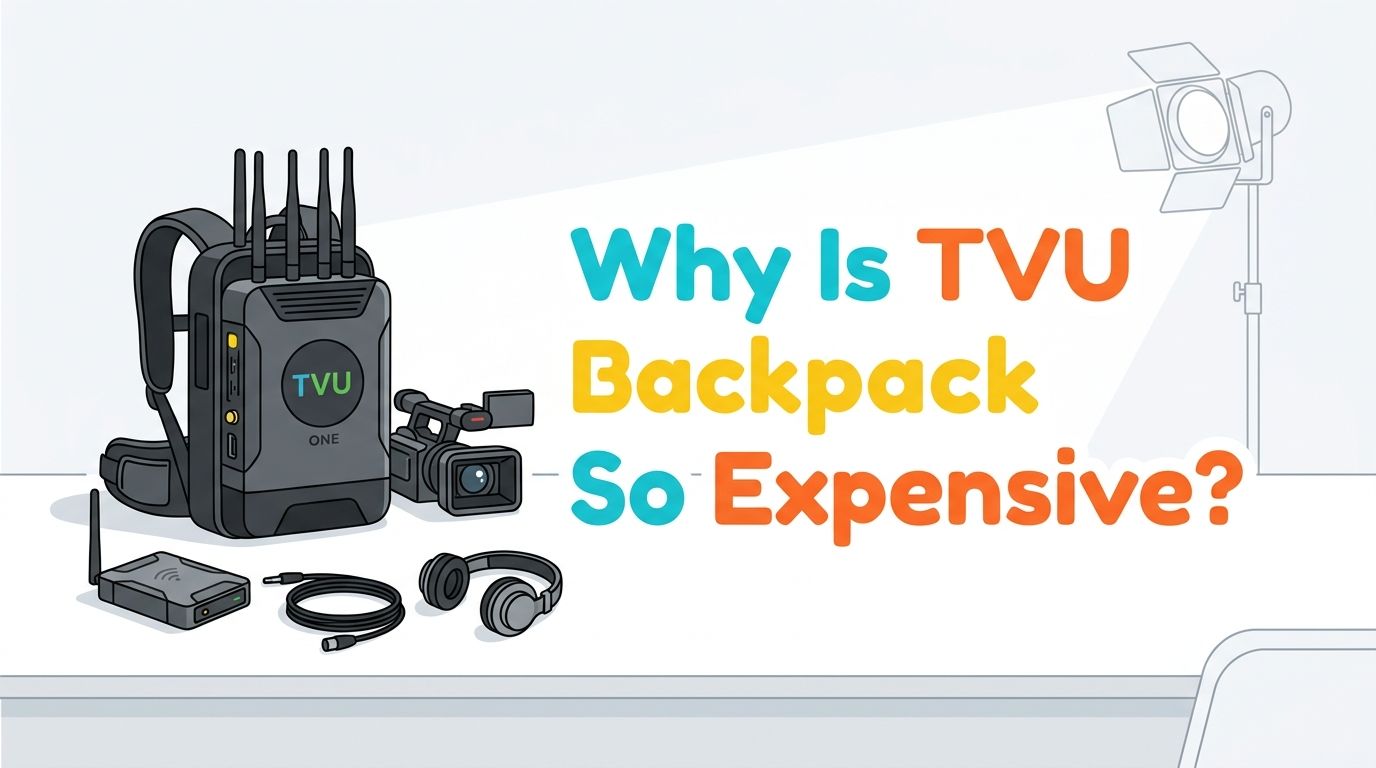
Why Is TVU Backpack So Expensive? The Real Reasons
If you have ever looked up the price of a TVU backpack, you probably did a double take. A single unit can cost anywhere from $10,000 to $30,000 or more, and that does not even include the batteries and data plans.
For IRL streamers, broadcast journalists, and content creators, this price tag raises a fair question: why is the TVU backpack so expensive?
The answer goes beyond a simple brand markup. TVU packs cutting edge cellular bonding hardware, six built in 5G modems, proprietary encoding software, and enterprise grade support into one compact device.
Key Takeaways
- The TVU One backpack costs between $10,000 and $30,000 depending on the configuration. The higher end setups include additional batteries, accessories, and data packages that push the total cost even further. Batteries alone can cost several thousand dollars each.
- Cellular bonding technology is the core reason for the high price. The TVU One bonds up to 12 connections from 5G, LTE, WiFi, and Ethernet simultaneously using proprietary ISX software. This technology took years of research and development to build.
- TVU originally built this hardware for broadcast news stations, not individual streamers. The price reflects an enterprise market where networks previously spent $500,000 or more on satellite uplink trucks. Compared to that, $30,000 is a bargain in the broadcast world.
- You do not always need a TVU backpack. Budget alternatives like DIY streaming setups using a smartphone, Speedify, and a portable hotspot can cost under $500. Mid range options like the LiveU Solo Pro sit around $1,000 to $3,000.
- Renting a TVU backpack is a cost effective option for one time events or short projects. Companies like ShareGrid and Feed Central offer daily and weekly TVU rentals starting around $500 per day.
- TVU recently launched TVU Go, a mobile app starting at $29 per month that brings some of the same cellular bonding technology to your smartphone, making the core technology accessible at a fraction of the hardware cost.
What Is the TVU Backpack and Who Uses It
The TVU backpack is a portable live video transmitter made by TVU Networks. It sends high quality video from remote locations to a receiving server or streaming platform using bonded cellular connections. The original TVUPack was created for broadcast news teams who needed a lighter, cheaper alternative to satellite trucks.
Today, the TVU One is the company’s flagship product. It supports 4K 50/60P video at up to 100 Mbps with latency as low as 0.3 seconds. Major news networks, sports broadcasters, and high profile IRL streamers like Kai Cenat, NMPLOL, and Cyr use this device.
The TVU backpack is popular because it provides broadcast level reliability in a portable form factor. It weighs only a few pounds, fits in a small bag, and replaces equipment that once required a full production van. The primary users include television journalists, event production teams, and professional content creators who stream outdoors or on the move.
The Real Reasons the TVU Backpack Costs So Much
The price of the TVU backpack is driven by several factors that all add up. First, the device contains six built in 5G modems that connect to multiple carriers at the same time. Each modem is a certified, carrier grade component, and packing six into a compact device is expensive.
Second, TVU uses proprietary ISX cellular bonding software. This software intelligently splits, sends, and reassembles video data across all available connections in real time. It took TVU Networks years of R&D to develop and patent this technology.
Third, the HEVC/H.265 hardware encoder inside the TVU One delivers professional quality compression. This chip alone costs significantly more than the software encoders found in consumer devices. Finally, the device includes 24/7 dedicated technical support, firmware updates, and cloud platform access, all bundled into the purchase price.
Cellular Bonding Technology Explained
Cellular bonding is the process of combining multiple internet connections into one stronger, more stable link. Instead of relying on a single 4G or 5G signal, the TVU backpack connects to several carriers at once. If one connection drops or slows down, the others pick up the slack instantly.
The TVU One can bond up to 12 simultaneous connections, including cellular, WiFi, and wired Ethernet. Its ISX algorithm distributes video packets across all links and reassembles them at the receiving end. This happens in real time with under half a second of delay.
This technology is what separates professional streaming hardware from a regular phone hotspot. A single connection is unpredictable in crowded areas like concerts, conventions, or city streets. Bonded cellular solves that problem by creating redundancy. The hardware and software required to do this reliably are the biggest contributors to the TVU backpack’s high price tag.
Enterprise Pricing vs Consumer Expectations
One important factor many creators overlook is that TVU Networks built its products for the enterprise broadcast market. Television stations, production companies, and news organizations are the original customers. These buyers compare the TVU backpack’s price to satellite trucks, which cost $300,000 to $500,000 or more.
From that perspective, a $20,000 to $30,000 portable transmitter is a massive cost savings. Enterprise clients also factor in reduced crew requirements, faster deployment, and lower ongoing operational costs. The ROI calculation makes perfect sense for a news network that deploys multiple units daily.
Individual streamers and small creators see the same price through a very different lens. For someone comparing a TVU backpack to a $200 webcam setup, the cost feels extreme. The reality is that TVU did not originally design this product for solo creators. The recent TVU One IRL Backpack branding is an attempt to bridge that gap, but the underlying technology and its price still reflect enterprise origins.
The Hidden Costs Beyond the Backpack Itself
The sticker price of the TVU backpack is only part of the total cost. Batteries are a major additional expense. Reports from creators indicate that a single TVU battery can cost several thousand dollars. You will likely need at least two for a full day of streaming, since each battery provides roughly 4 to 4.5 hours of transmission time.
Data costs add up quickly too. Streaming high quality video over bonded 5G connections consumes large amounts of data. You will need multiple SIM cards from different carriers, each with a generous data plan. Depending on your country and carriers, this can add $100 to $500 or more per month.
Some configurations also require a TVU Receiver or cloud server subscription to decode and route the video feed to your streaming platform. These additional components and services can push the total cost of ownership well above the base price of the hardware.
Is the TVU Backpack Worth It for IRL Streamers
The answer depends on your streaming volume, income, and quality requirements. If you are a full time IRL streamer earning significant revenue from subscriptions, donations, and sponsorships, a TVU backpack can pay for itself. The ultra low latency and rock solid connection keep your audience engaged and reduce lost revenue from dropped streams.
Pros of the TVU backpack for streamers: Unmatched connection stability, sub second latency at 0.3 seconds, one click go live functionality, built in 5G modems eliminate external devices, and 24/7 support is included.
Cons of the TVU backpack for streamers: Extremely high upfront cost, expensive batteries sold separately, ongoing data plan costs, overkill for casual or beginner streamers, and the device has a learning curve for initial setup.
For part time or hobbyist streamers, the TVU backpack is difficult to justify financially. The technology is outstanding, but the price only makes sense if streaming is a primary income source.
Renting a TVU Backpack to Save Money
If you need TVU level quality for a specific event or project, renting is a smart alternative to buying. Several equipment rental platforms offer the TVU One for daily, weekend, or weekly rates. ShareGrid in Los Angeles lists the TVU One at around $4,000 per day. Feed Central offers rentals with included data packages starting at lower rates for multi day bookings.
Pros of renting: No massive upfront investment, access to professional grade equipment for special occasions, data packages often included in rental pricing, and no long term maintenance or storage responsibilities.
Cons of renting: Expensive for frequent use, availability may be limited during peak event seasons, you must return the equipment and cannot customize settings permanently, and rental fees add up if you need the unit more than a few times per year.
Renting works best for one time events, test runs, or creators who want to try the TVU backpack before committing to a purchase. TVU Networks also runs its own global rental program for broadcast clients.
TVU Go: The Affordable App Alternative
In April 2026, TVU Networks launched TVU Go, a mobile app that brings cellular bonding technology to smartphones. TVU Go combines cellular and WiFi connections into a single, more stable stream, adapting in real time to changing network conditions. It is available on both iOS and Android.
Pricing starts at $29 per month for the Starter plan, which includes 50 hours of streaming. This makes TVU’s core bonding technology accessible to creators who cannot afford the full hardware package.
Pros of TVU Go: Extremely affordable compared to the hardware, works on devices you already own, uses proven TVU bonding technology, includes a 3 day free trial, and eliminates the need for external modems.
Cons of TVU Go: Performance depends on your phone’s hardware and available networks, it will not match the reliability of six dedicated 5G modems in the TVU One, and latency will likely be higher than the hardware solution.
TVU Go is an excellent entry point for creators who want better connection stability without spending thousands of dollars.
Budget DIY Streaming Backpack Alternatives
You can build a functional IRL streaming backpack for under $500 using off the shelf components. The basic setup includes a smartphone or action camera, a portable battery pack, one or two USB cellular modems, and channel bonding software like Speedify.
Speedify is a software based bonding solution that combines WiFi and cellular connections on your phone or laptop. It costs around $15 per month and works with standard consumer hardware. Pair it with a decent phone and a GoPro, and you have a mobile streaming setup.
Pros of the DIY approach: Very low cost, fully customizable, easy to replace individual parts, and great for learning the basics of IRL streaming before investing in premium gear.
Cons of the DIY approach: Lower video quality and stability compared to TVU, higher latency, requires more technical knowledge to set up and troubleshoot, and the bonding performance of software solutions is weaker than dedicated hardware.
Some creators have even built Raspberry Pi based streaming backpacks for as little as $75 to $200, though these require significant technical skill.
Mid Range Options: LiveU Solo and Similar Devices
The LiveU Solo Pro sits in the middle ground between a DIY setup and a TVU backpack. Priced around $1,000 to $3,000 depending on the model and configuration, it offers hardware based cellular bonding with LRT technology in a compact form factor.
LiveU Solo bonds multiple LTE connections and supports direct streaming to platforms like Twitch, YouTube, and Facebook. It is widely used by IRL streamers who need reliable outdoor streaming without the TVU price tag.
Pros of mid range devices: Significantly cheaper than TVU, purpose built hardware for live streaming, good connection stability for most situations, and active user communities for support.
Cons of mid range devices: Fewer bonded connections than TVU One, higher latency compared to TVU’s 0.3 second performance, may require a monthly subscription for management software, and connection quality can drop in very congested areas.
Other options in this range include devices from AVIWEST and Teradek, both of which offer portable bonded cellular transmitters at various price points.
How to Decide What You Actually Need
Start by asking yourself three questions. How often do you stream outdoors? If the answer is less than once a week, a DIY or phone based setup will serve you well. How much revenue does your streaming generate? If your monthly streaming income exceeds the cost of a TVU rental, the investment starts to make sense.
What level of quality does your audience expect? Viewers of casual IRL streams tolerate occasional buffering and lower resolution. Broadcast quality audiences and professional clients expect zero drops and perfect audio.
Create a simple cost benefit spreadsheet that compares the total annual cost of each option. Include hardware, data plans, batteries, software subscriptions, and rental fees. Many creators find that a mid range solution like LiveU Solo Pro combined with a good data plan covers 90% of their needs at 10% of the TVU cost.
Steps to Get Started with IRL Streaming on a Budget
Step 1: Use your existing smartphone as the camera and encoder. Modern phones handle 1080p streaming with ease. Download a streaming app like Larix Broadcaster or TVU Anywhere.
Step 2: Purchase a portable power bank with at least 20,000 mAh capacity. This will keep your phone running for 6 to 8 hours. Quality power banks cost between $30 and $60.
Step 3: Install Speedify or a similar bonding app on your phone. Connect to both WiFi and cellular simultaneously. This gives you basic connection redundancy for under $15 per month.
Step 4: Test your setup at home first. Stream for 30 minutes while walking around your neighborhood. Check for audio sync issues, video quality, and connection stability.
Step 5: Upgrade incrementally. Add a better camera, a second modem, or switch to TVU Go as your audience and income grow. You do not need to spend $30,000 on day one. Let your equipment budget grow alongside your channel.
Final Thoughts on the TVU Backpack Price
The TVU backpack is expensive because it delivers genuine broadcast quality performance in a portable device. The cellular bonding hardware, proprietary software, built in 5G modems, and enterprise support all justify the cost for professional broadcasters and high earning streamers. But most creators can achieve solid IRL streaming results with far less expensive tools.
Start with what you have. Test the waters with budget gear. Upgrade when your streaming income supports it. The technology is getting cheaper and more accessible every year, and options like TVU Go at $29 per month prove that the gap between professional and consumer streaming tools is closing fast.
Frequently Asked Questions
How much does a TVU backpack cost in 2026?
The TVU One backpack costs between $10,000 and $30,000 depending on the specific model and configuration. Higher end setups that include multiple batteries, extra accessories, and data packages can push the total investment above $35,000. Rental options are available starting at a few hundred dollars per day for those who need the device temporarily.
Can I use a TVU backpack for Twitch streaming?
Yes. The TVU One supports direct streaming to Twitch, YouTube, Facebook, and other major platforms. Many popular Twitch IRL streamers use the TVU backpack for outdoor broadcasts. The device connects to your streaming platform through the TVU cloud ecosystem and can go live with a single button press.
What is the cheapest alternative to a TVU backpack?
The cheapest functional alternative is a DIY setup using a smartphone, a portable battery, and Speedify bonding software. This combination costs under $200 (excluding the phone) and provides basic cellular bonding. For a more reliable mid range option, the LiveU Solo Pro costs between $1,000 and $3,000.
Does the TVU backpack require a monthly subscription?
The TVU One hardware does not require a traditional monthly subscription fee for basic operation. However, you will need to pay for mobile data plans on multiple SIM cards, which creates an ongoing monthly cost. Some cloud features and advanced integrations may also carry additional fees. TVU Go, the mobile app alternative, does operate on a monthly subscription model starting at $29.
Why do streamers like Kai Cenat use TVU backpacks?
High profile streamers choose the TVU backpack because it provides the most reliable connection available for outdoor live streaming. With 0.3 second latency and six bonded 5G modems, it virtually eliminates dropped frames and buffering. For creators whose streams generate thousands of dollars per hour, the cost of the TVU backpack is a worthwhile investment to protect that revenue.

Hi, I’m Luna Beck — the founder and voice behind Urban Pack Vault. I’m passionate about helping people find bags that perfectly match their lifestyle. From backpacks to travel luggage, I research, review, and recommend so you never have to second-guess your next purchase.