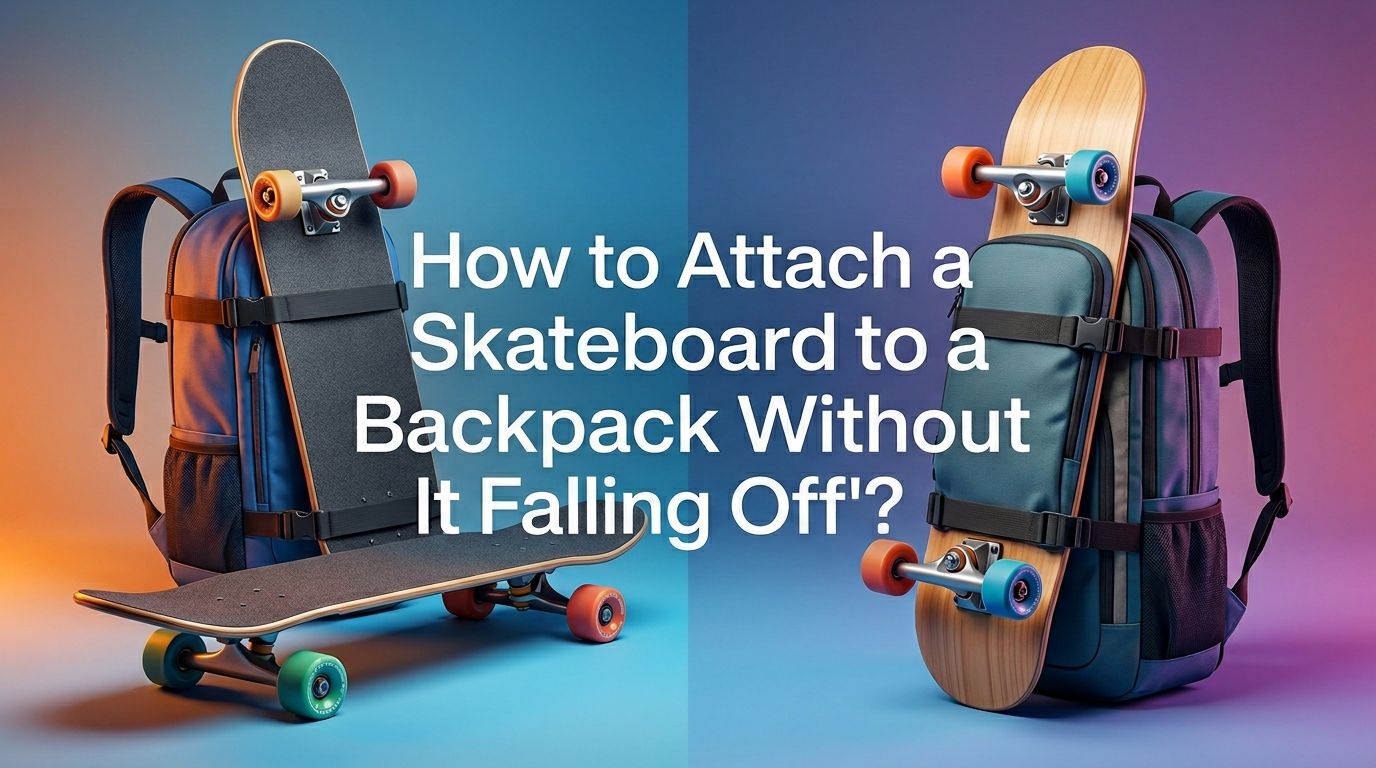
How to Attach a Skateboard to a Backpack Without It Falling Off?
You just finished skating, and now you need to walk, bike, or catch the bus. Holding a skateboard in one hand gets old fast. Your arm gets tired. Your grip slips. You bump into people.
There has to be a better way, right? The good news is that you can attach your skateboard to a standard daypack and keep both hands free.
The bad news? If you do it wrong, your board can swing around, scratch up your bag, or worse, fall off and roll into traffic.
In a Nutshell
- The shoulder strap method is the quickest free option. You slide the board between your back and the backpack, resting the trucks on the top edge of the bag. This works best for short walks and lighter boards, but it can shift around if you move fast.
- Bungee cords and velcro straps offer a cheap, reliable upgrade. A pair of adjustable straps wrapped around the board and the backpack body holds the deck firm. This method costs very little and works on almost any daypack.
- Carabiner clips attached to the truck axles give a fast clip on and clip off solution. You hook the carabiner through the truck hardware and clip it onto the backpack’s daisy chain or top loop. This works best for bags with strong external attachment points.
- DIY sewn on straps turn any backpack into a skate pack permanently. Using nylon webbing, buckle clips, and basic sewing skills, you can add two horizontal straps to the front panel. This is the most secure long term solution.
- Grip tape orientation matters for safety and comfort. Always face the grip tape side toward the backpack to prevent it from scratching your clothes or catching on objects around you.
- Weight distribution is key to comfort. Position the board vertically and centered on the bag to avoid pulling your shoulders to one side. Tighten all straps so the board sits snug against the pack with zero wobble.
How to Use the Shoulder Strap Tuck Method?
The simplest way to carry a skateboard on a backpack is the shoulder strap tuck. You slide the board vertically between your back and the backpack. The top truck rests on the bag’s top edge, and the bottom truck hangs near your lower back.
Loosen your shoulder straps slightly so there is a small gap between the bag and your back. Slide the board in with the grip tape facing the backpack. Then tighten the straps back down. The tension from the straps keeps the board pressed against the bag.
Pros: This method is completely free. It requires no extra gear. You can do it in seconds.
Cons: The board can slip out during fast walking or running. The trucks may dig into your back. It only works well with medium to large daypacks that cover enough of the board.
How to Attach a Skateboard with Bungee Cords?
Bungee cords are one of the most popular and affordable tools for this job. You need two bungee cords, each about 18 to 24 inches long. Place the skateboard flat against the front panel of the backpack with the grip tape facing inward.
Wrap one bungee cord around the top truck and through the bag’s top handle or upper attachment loop. Wrap the second bungee cord around the bottom truck and through the bag’s lower daisy chain or bottom strap. Hook both cords tightly.
Pros: Bungee cords are cheap, easy to find, and hold the board firmly. They also stretch to fit different board sizes.
Cons: The hooks on bungee cords can scratch your bag over time. If a cord snaps, the board drops immediately. You should check the cord tension before each use.
How to Secure a Board Using Velcro Straps?
Velcro straps give you a clean, adjustable, and reusable solution. Buy two heavy duty velcro straps that are at least 12 inches long and 1 inch wide. These are often sold as cable management straps or garden ties.
Place the board vertically on the backpack’s front panel. Wrap one strap around the board and the bag just below the top truck. Wrap the second strap around the board and bag just above the bottom truck. Press the velcro tight and make sure there is no slack.
Pros: Velcro straps are quiet, lightweight, and easy to adjust. They do not scratch the bag. They fold flat when not in use.
Cons: Cheap velcro can lose its grip after many uses. Very heavy boards may cause the straps to peel open if the adhesion weakens. Choose straps rated for at least 15 pounds of hold strength.
How to Clip a Skateboard On with Carabiners?
Carabiners offer a fast and satisfying clip on, clip off experience. You need two large, sturdy carabiners. Aluminum ones rated for at least 25 pounds work well. Do not use flimsy keychain carabiners because they can bend under weight.
Open a carabiner and loop it around one of the truck axles on your skateboard. Then clip the carabiner onto a strong loop or daisy chain on the outside of your backpack. Repeat with the second carabiner on the other truck.
Pros: This method is quick to use. Carabiners are durable and last for years. They work on many different bag styles.
Cons: Your backpack must have strong external loops or attachment points. The board hangs loosely and can swing while you walk. You may need an extra strap at the bottom to reduce movement.
How to Sew DIY Skateboard Straps onto a Backpack?
For a permanent and professional setup, you can sew nylon webbing straps directly onto your backpack. You will need about 4 feet of 1 inch nylon webbing, two plastic side release buckle clips, a heavy duty needle, and strong polyester thread.
Cut the webbing into two equal pieces. Sew one end of each strap to the front panel of the backpack at the height where your trucks will sit. Attach the buckle clips to the free ends. Now you can lay the board flat on the front panel, wrap the straps over it, and click the buckles shut.
Pros: This gives the most secure hold. The board will not shift, swing, or fall off. You get the same function as a dedicated skate backpack.
Cons: You need basic sewing skills. You permanently alter your backpack. If you sew the straps in the wrong position, the board will not sit correctly.
How to Position the Skateboard for Comfort?
Where you place the board on the bag changes how it feels on your body. The best position is vertical and centered on the backpack’s front panel. This keeps the weight close to your spine and prevents the pack from tilting to one side.
If the board sits too high, it will bump the back of your head. If it sits too low, it will hit your legs while you walk. Aim to center the board so the middle of the deck aligns with the middle of your backpack.
Make sure the trucks face outward if the board is on the back panel, so the flat deck rests against the bag. If the board is between your back and the bag, the trucks should face away from your spine to avoid discomfort.
How to Prevent the Grip Tape from Damaging Your Bag?
Skateboard grip tape is essentially coarse sandpaper. It will scratch, scuff, and wear through fabric if it rubs against your bag with every step. This is a common problem that many skaters overlook until the damage is done.
The easiest fix is to always face the grip tape inward against the backpack. Place a thin layer of protection between the tape and the bag. An old shirt, a bandana, or a thin foam pad works perfectly.
You can also apply a strip of duct tape or gaffer tape over the area of the bag where the grip tape makes contact. This sacrificial layer absorbs the friction and can be replaced cheaply. Check the contact area every few weeks for signs of wear.
How to Distribute Weight Evenly While Carrying a Board?
An unbalanced load puts stress on your shoulders, neck, and lower back. A skateboard adds 7 to 11 pounds to your pack, and that extra weight can cause discomfort on longer walks if it is not distributed properly.
Tighten both shoulder straps equally so the pack sits high on your back. Use the sternum strap and hip belt if your daypack has them. These straps transfer weight from your shoulders to your hips, which reduces fatigue.
Pack heavier items inside the bag close to your back and lighter items near the front. The skateboard should sit flat against the pack with no gaps. This keeps the center of gravity close to your body and prevents the bag from pulling you backward.
How to Keep the Skateboard Secure on Public Transit?
Buses, trains, and subways involve sudden stops, tight spaces, and crowds. A skateboard that is loosely attached to your pack becomes a hazard for you and the people around you.
Before boarding, double check every strap, cord, or clip holding the board. Give the board a firm tug to test the hold. If the board moves more than half an inch, tighten everything down. On a crowded train, stand with your back against a wall so the board does not bump other passengers.
If you need to sit down, remove the board from the backpack and hold it between your legs with the grip tape facing your shins. This is safer and takes up less space. Always be aware of the board’s position so it does not block doorways or trip someone.
How to Choose the Right Backpack for Skateboard Carrying?
Not every daypack works well for carrying a skateboard. The ideal backpack has strong external attachment points, a flat front panel, and a capacity of at least 25 liters. Look for bags with daisy chains, compression straps, or MOLLE webbing on the front.
The bag’s back panel padding also matters. Thicker padding makes it more comfortable to carry a board between the bag and your back. Padded shoulder straps at least 2 inches wide help distribute the combined load.
Pros of choosing the right bag: Everything fits better. The board stays centered. The carry feels natural even on long walks.
Cons of upgrading your bag: It may cost more upfront. You might need to replace a pack you already like. Some feature rich bags are heavier on their own.
How to Avoid Common Mistakes That Cause Boards to Fall?
The number one mistake is using weak attachment points. Thin decorative loops on a bag are not made to hold 10 pounds of skateboard. Always attach to structural loops, handles, or straps that are reinforced with bar tacking.
The second mistake is not checking your setup before you leave. Straps loosen over time. Bungee cords stretch out. Velcro collects lint and loses grip. Spend ten seconds testing the hold each time you strap the board on.
The third mistake is hanging the board from a single point. Always use at least two attachment points, one near each truck. A single connection lets the board swing like a pendulum, and that swinging motion will eventually work the strap loose.
How to Carry a Skateboard Safely in Rainy or Wet Conditions?
Rain is not just annoying. It is destructive to skateboard bearings and wooden decks. If your board gets soaked, the wood can warp and the bearings can rust. Protecting the board during transport matters just as much as riding conditions.
Wrap the board in a large plastic bag or trash bag before strapping it to your pack. This keeps moisture off the deck and bearings. If you commute in rain regularly, consider a waterproof board bag made from nylon or vinyl.
Position the board so the grip tape faces down or inward. Grip tape holds water like a sponge and takes a long time to dry. Keeping it shielded from direct rain exposure will extend its life significantly.
How to Remove the Board Quickly When You Need to Ride?
Speed of access matters if you skate as part of your commute. You do not want to fumble with complicated straps every time you reach a skateable stretch of road. The best systems let you remove the board in under five seconds.
Bungee cords and carabiners are the fastest to undo. Velcro straps come off quickly with a firm pull. Buckle straps take a few more seconds but are still fast enough for regular use. Practice the removal motion a few times so it becomes automatic.
Keep the straps or cords accessible, not buried under jacket flaps or other gear. Some skaters attach a small hook or clip to keep unused straps neatly bundled while riding. This prevents them from dragging or getting caught in wheels.
Frequently Asked Questions
How Heavy Is a Standard Skateboard for Backpack Carrying?
A standard complete skateboard weighs between 7 and 11 pounds. This includes the deck, trucks, wheels, bearings, and hardware. Most daypacks can handle this extra weight with proper strap adjustment. If your pack already holds 15 or more pounds of gear, adding a skateboard means you should use the hip belt to reduce shoulder strain.
Can I Fit a Longboard on a Regular Daypack?
Longboards are 36 to 46 inches long, which is much larger than a standard 31 inch skateboard. Most daypacks cannot fully support a longboard. The board will extend far above and below the bag, making it unstable. You can still use bungee cords or carabiners, but expect more swinging and shifting. A dedicated longboard bag or a larger hiking pack works better for longboards.
Will Carrying a Skateboard on My Back Damage My Backpack?
Yes, it can cause damage over time. The trucks can poke through thin fabric, and grip tape acts like sandpaper on the material. Use protective layers like foam pads, old shirts, or tape on the contact areas. Rotate the board position slightly each time you attach it so the same spot does not get all the wear.
Is It Safe to Bike with a Skateboard Strapped to My Backpack?
It is possible but requires extra caution. The board adds bulk and changes your center of gravity. Make sure the board is very tightly secured so it cannot shift while you pedal. Keep speeds moderate and avoid sharp turns. The wider profile of your back can catch wind, so watch for gusts on open roads.
What Is the Cheapest Way to Carry a Skateboard on a Backpack?
The cheapest method is the shoulder strap tuck, which costs nothing. The next cheapest option is a pair of velcro straps or bungee cords, which cost just a few dollars at any hardware store. Both methods work well for standard sized skateboards and regular daypacks.

Hi, I’m Luna Beck — the founder and voice behind Urban Pack Vault. I’m passionate about helping people find bags that perfectly match their lifestyle. From backpacks to travel luggage, I research, review, and recommend so you never have to second-guess your next purchase.