How To Measure Torso Length For A Hiking Backpack?
Finding the right hiking backpack starts with one number that most people skip. That number is your torso length. Many hikers buy a pack based on their height, then wonder why their shoulders ache after a few miles.
The truth is simple. Your torso length, not your height, decides which pack size fits you best. A pack that matches your torso shifts weight onto your hips, where your strongest muscles live.
A pack that does not match your torso pulls on your shoulders and leaves you sore. The good news is that measuring your torso takes only a few minutes.
Key Takeaways
- Torso length beats height every time. Two people of the same height can wear different pack sizes because their torso lengths differ. Always measure your torso instead of guessing from your overall height.
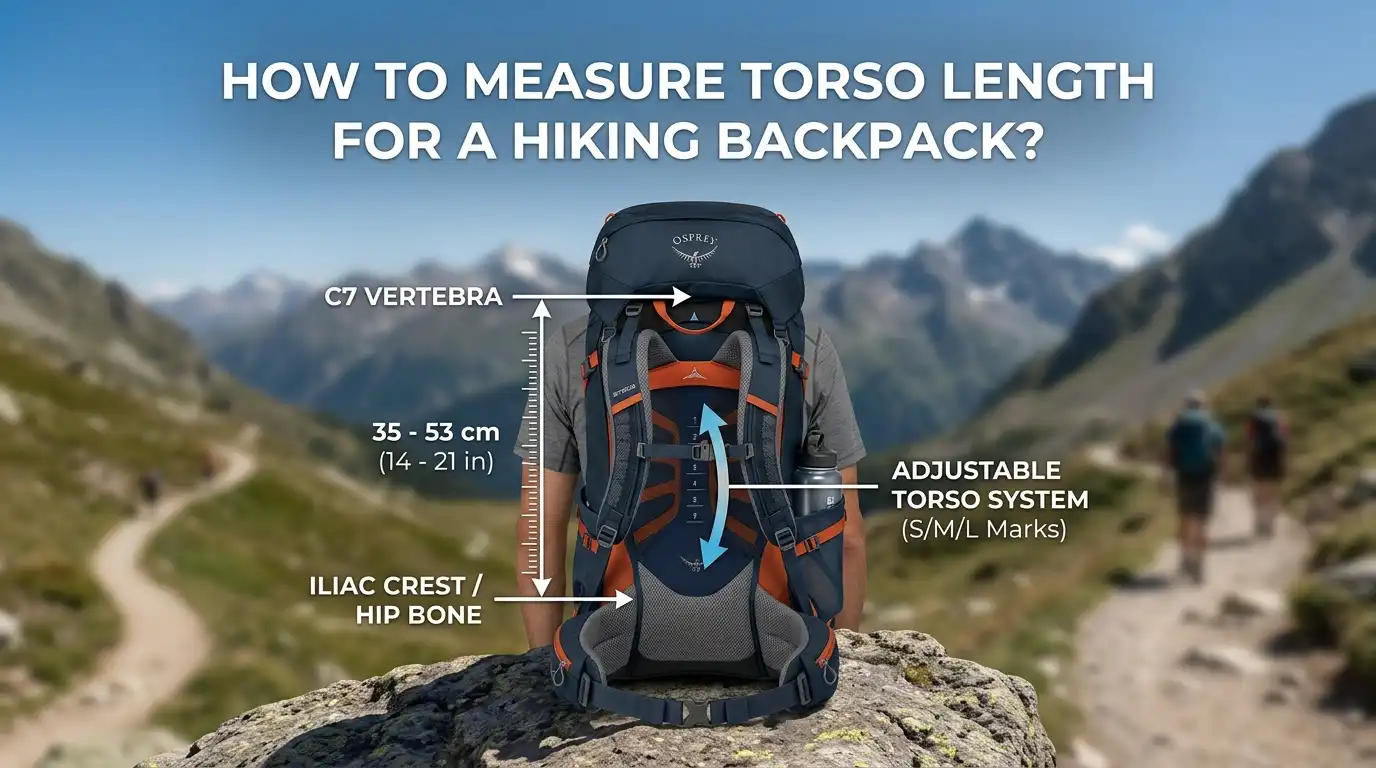
- Find two body points first. Your measurement runs from the C7 vertebra at the base of your neck down to your iliac crest, the top edge of your hip bones. These two spots mark the top and bottom of your torso.
- Use a soft tape and a helper. A flexible fabric tape measure gives you an accurate reading. A friend makes the job far easier because you cannot reach your own spine well.
- Match your number to a size chart. Most packs come in small, medium, and large ranges measured in inches. A reading of 18 inches usually points to a medium pack.
- Check your hip size too. You carry most of the weight on your hips, so measure around your iliac crest to confirm the hip belt fits snugly.
- Try the pack on with weight. Home measurements are rarely perfect, so load the pack with about 15 pounds and adjust the straps to confirm comfort.
Why Torso Length Matters More Than Your Height
Many shoppers assume a tall person needs a large pack and a short person needs a small one. This assumption causes more fit problems than almost anything else. Your height includes your legs, neck, and head, none of which carry your backpack.
Only your torso does that job. Two friends who both stand six feet tall can have very different torso lengths. One might have long legs and a short back, while the other has the opposite build. If both buy the same size pack, only one will feel comfortable.
The torso is the section of your spine that holds the suspension system of your pack. When the pack length matches this section, the hip belt lands on your hips and the shoulder straps wrap your shoulders correctly.
A mismatch forces the weight upward and tires you out fast. This single measurement protects your back, shoulders, and overall hiking joy.
What You Need Before You Start Measuring
Gathering your tools first makes the whole process smooth. You only need three simple things, and none of them cost much. First, grab a soft fabric tape measure, the kind tailors use for clothing.
This flexible tape bends along the curve of your spine and gives a true reading. A stiff metal tape or a wooden ruler will not follow your back and will produce a wrong number. Second, find a friend or family member to help you.
You cannot see or reach your own spine well, so a helper makes the measurement far more accurate. Third, wear thin, fitted clothing. Bulky sweaters or thick jackets add inches that do not belong to your body.
You may also want a mirror and a pen to mark spots if you measure alone. Stand on a flat floor in your socks. With these items ready, you can finish the whole task in under five minutes.
How To Find Your C7 Vertebra (The Top Point)
The top of your torso measurement sits at a bony bump on your spine called the C7 vertebra. Finding this point correctly sets the foundation for an accurate reading. Start by tilting your head forward and looking down at the floor.
Run your fingers along the base of your neck where it meets your shoulders. You will feel a bump that sticks out more than the others. This is your seventh cervical vertebra, known as the C7.
To confirm you found the right spot, place a finger on the bump and lift your head back up. The bump that moves the least and stays the most prominent is your C7. This is the exact top of your torso length.
Some people have a clear, easy to feel bump, while others need to press a little harder. Ask your helper to mark this spot lightly with a washable pen so you do not lose it during the measurement.
How To Locate Your Iliac Crest (The Bottom Point)
The bottom of your torso measurement rests at your iliac crest, the top ridge of your hip bones. This point tells you where the hip belt of your pack will sit. To find it, place your hands on your waist just under your ribcage.
Slide your hands downward while gently pressing in until they stop on a firm, shelf like bone. That bone is the top of your pelvis, called the iliac crest. Now point your thumbs toward your spine and your index fingers forward.
Draw an imaginary line straight across your lower back between your two thumbs. The spot where this line crosses your spine marks the bottom of your torso. This is not the same as your natural waist or your pant line, which usually sits lower.
Getting this point right keeps your measurement true. Ask your friend to mark the spine spot with the pen so you have a clear bottom reference for the tape.
Step By Step: Measuring Your Torso Length At Home
Now you combine both points into one clean measurement. Follow these steps in order for the best result. First, stand up straight with your back relaxed and your eyes forward. Do not slouch or arch your back, since posture changes the number.
Have your friend place the start of the tape on your marked C7 vertebra. Next, ask them to run the tape down the natural curve of your spine. The tape should follow the contour of your back, not hang straight in the air.
Stop the tape at the line you marked across your iliac crest. Read the number where the tape meets that lower mark. This number, usually between 15 and 23 inches for most adults, is your torso length.
Measure two or three times to confirm you get the same result each time. If your readings differ by more than half an inch, recheck your two marked points and try again slowly.
Pros: This method costs nothing and takes minutes. Cons: It needs a helper and can be slightly off without careful marking.
How To Measure Your Torso Length Alone
Sometimes you have no helper nearby, and you still want your number. You can measure solo with a few clever tricks, though it takes more care. Stand with your back to a wall and a large mirror in front of you.
Mark your C7 vertebra and your iliac crest line with a washable pen first, just as before. Then hold the start of the tape at your C7 by reaching one hand behind your neck. Let the tape drape down your spine and press it against your back with your other hand.
Use the mirror to read where the tape crosses your iliac crest mark. Another option uses sticky notes. Place one note at each point, then lie the tape between them on a flat surface and measure the distance.
Phone cameras also help, since you can photograph your back and check the marks later. These methods work, but they trade some accuracy for independence.
Pros: No helper required and full control over the process. Cons: Harder to keep the tape straight and easier to misread the points.
Understanding Backpack Size Charts And Torso Ranges
Once you have your number, you need to match it to a pack. Brands group packs into size ranges measured in inches of torso length. A common chart looks like this: a small pack fits roughly 15 to 17 inches, a medium fits 17 to 19 inches, and a large fits 19 to 21 inches.
Some brands add extra small at around 14 to 16 inches and extra large above 21 inches. These ranges overlap on purpose, so a person with an 18 inch torso could fit a small or a medium depending on the brand.
Always read the chart for the exact pack you want, because numbers shift between companies. If your measurement falls right between two sizes, lean toward the size that gives you room to adjust.
Many packs include an adjustable suspension that stretches the range further. Checking the chart before you buy saves you from costly returns and uncomfortable hikes.
How To Measure Your Hip And Waist Size
Your torso is the main number, but your hips carry the load. A good hip belt fit matters because your hips hold most of the pack weight. To measure your hip size, wrap the soft tape around the top of your hips, right over the iliac crest you found earlier.
This line sits a little higher than your normal belt line, so it differs from your pant size. Pull the tape snug but not tight, and read the number. This circumference tells you whether the hip belt will close comfortably.
For a proper fit, the padded part of the belt should extend two to four inches past your hip bones on each side. You also want at least one inch of space on either side of the center buckle.
If the belt feels too loose or too tight, many packs offer swappable hip belts in different sizes. Confirming this measurement keeps the weight where it belongs.
Common Mistakes That Ruin Your Measurement
Small errors lead to big fit problems, so watch for these traps. The most frequent mistake is slouching while you measure. Poor posture shortens or lengthens your spine and throws off the number. Always stand tall and natural with your shoulders relaxed.
Another common error is confusing your natural waist with your iliac crest. Your waist sits higher and softer, while the iliac crest is the firm bone below it. Measuring to the wrong point can add or remove a full inch.
Some people use a stiff ruler instead of a soft tape, which cannot follow the curve of the back. Thick clothing is another quiet culprit that pads your reading.
People also forget to measure more than once, so a single bad pull becomes their final number. Take three readings and trust the one that repeats. Avoiding these mistakes gives you a number you can rely on for years.
How To Confirm The Fit When You Try The Pack On
A measurement points you to a size, but the real test comes when you wear the pack. Home numbers are rarely perfect, so trying the pack on confirms your choice. Load the pack with about 15 pounds to mimic a real hike.
Loosen every strap first, then put the pack on and fasten the hip belt over the top of your hips. The padded belt should hug your iliac crest, not float above it or sag below it. Next, tighten the shoulder straps gently.
The strap anchor points should sit one to two inches below the top of your shoulders. If they sit higher or lower, your torso length on the pack may be set wrong.
Check that the load lifter straps angle back at about 45 degrees from your shoulders. When all four straps feel balanced and the weight rests on your hips, the size is correct. If something feels off, recheck the torso setting before blaming the size.
Adjusting Packs With Adjustable Suspension Systems
Many modern packs let you slide the back panel up or down to change the torso length. This feature lets one pack fit a wider range of bodies. If your pack has an adjustable suspension, setting the torso length is your first and most important adjustment.
Match the suspension setting to the torso number you measured at home. Most systems use a ladder of velcro panels, hook slots, or a sliding rail that you move and lock in place. Once you set this length, the other straps can do their job correctly.
If your shoulder straps or hip belt refuse to sit right no matter how you pull them, reset the suspension first. Straps cannot fix a torso length that is set wrong.
Adjustable packs help if you fall between two fixed sizes or if you share a pack with family. The trade off is a little extra weight and a few more parts that can wear over time.
Pros: One pack fits many torso lengths and adapts as your needs change. Cons: It adds weight and adds parts that need occasional checking.
Tips For Measuring Kids And Growing Hikers
Children grow fast, so their pack needs change often. Measuring a child uses the same C7 to iliac crest method, just on a smaller frame. Have the child stand straight while you mark both points with a washable pen.
Kids often wiggle, so make the measurement quick and calm. Because young hikers keep growing, an adjustable youth pack makes the most sense. These packs extend their torso range so the pack lasts more than one season.
Remeasure your child every few months, since a growth spurt can change their torso length quickly. Do not buy a pack that is far too big in hopes they will grow into it, because an oversized pack rides poorly and can strain a young back.
Instead, pick a pack that fits now with a little room to extend. Keep loads light for children, generally no more than ten to fifteen percent of their body weight. A good fit early builds a lifelong love of hiking.
Frequently Asked Questions
Is torso length the same as my shirt size?
No, torso length and shirt size measure different things. Your shirt size depends on chest width, sleeve length, and overall build, while torso length measures only the distance from your C7 vertebra to your iliac crest. You must measure your torso directly to get the right pack size. A large shirt does not mean a large pack.
What is the average torso length for adults?
Most adult torso lengths fall between 16 and 20 inches. Many men measure around 18 to 20 inches, while many women measure around 16 to 18 inches, though individual builds vary widely. Your personal number matters far more than any average, so always measure yourself rather than relying on typical figures.
Can I use my height to pick a pack instead?
You can estimate, but height alone often leads to a poor fit. Height includes your legs and neck, which do not carry the pack. Two people of equal height can need different pack sizes. Measuring your torso gives a reliable number that height cannot match, so it is worth the few minutes it takes.
What if my torso length falls between two sizes?
When you land between sizes, try both packs if you can. Pick the size that lets you adjust the straps comfortably with room to spare. A pack with adjustable suspension solves this problem nicely because it stretches across both ranges. If you must choose one fixed size, the smaller one often rides closer to your back.
How often should I remeasure my torso?
Adults rarely need to remeasure unless their posture, weight, or build changes noticeably. Children and teens should be measured every few months because they grow quickly. A growth spurt can add an inch to a young hiker fast. Remeasuring keeps the pack fitting well and protects a growing back from strain.
Does the pack brand change the size chart?
Yes, size ranges shift between brands and even between models from the same brand. A medium in one brand may equal a small in another. Always read the exact size chart for the pack you want before buying. Your torso number stays the same, but the size label that matches it can change.

Hi, I’m Luna Beck — the founder and voice behind Urban Pack Vault. I’m passionate about helping people find bags that perfectly match their lifestyle. From backpacks to travel luggage, I research, review, and recommend so you never have to second-guess your next purchase.